Showing posts with label Korea. Show all posts

Friday, November 25, 2011

Korea needs soccer to beat out Japan ?

Japan must again be absolutely furious at Korea again being closer to the center of the world that just happens to not just be the center of Asia.It must be Japan's fate that a powerful farm lobby was the one that pushed the KORUS(Korea United States Free Trade Treaty) forward and from the view of misguided nationalists of Korea (Democratic Party of Korea) one that was not powerful enough in South Korea to prevent the ratification of American Beef to South Korea or Japanese capital and American machinery sales into and to South Korea(KORUS) rather than the opposite way around as has come to characterize the Korea-United States relationship in or, equivalently, small car expertise for China, has come to symbolize.

Sunday, September 19, 2010

There seems to be a problem with the Economist's Map...

In an article outlining heightened tensions between China and Japan (again), the map on the article by the Economist seems to label the Liancourt Rocks (Dokdo/Takeshima) as part of Japanese territory or being part of Japan's exclusive economic zone. The Senkaku/Diaoyu island chains are demarcated as such, whereas the Kuril Islands -- including the lower two --  are marked as Russian territory. So, it's a bit puzzling that the Liancourt Rocks are labeled to be a part of Japan. Clearly this is a matter of grave concern as, well, heaven forbid if fifty years later Japanese -- or for that matter any nationalist "historian"-- were to say, look here, we found an old map by the Economist clearly showing that Takeshima is a part of Japan.

And, by the way, a quick look at the second map shows exactly why the Liancourt Rocks seem to be so important. It takes up such a huge chunk of the seas east of the Korean peninsula.

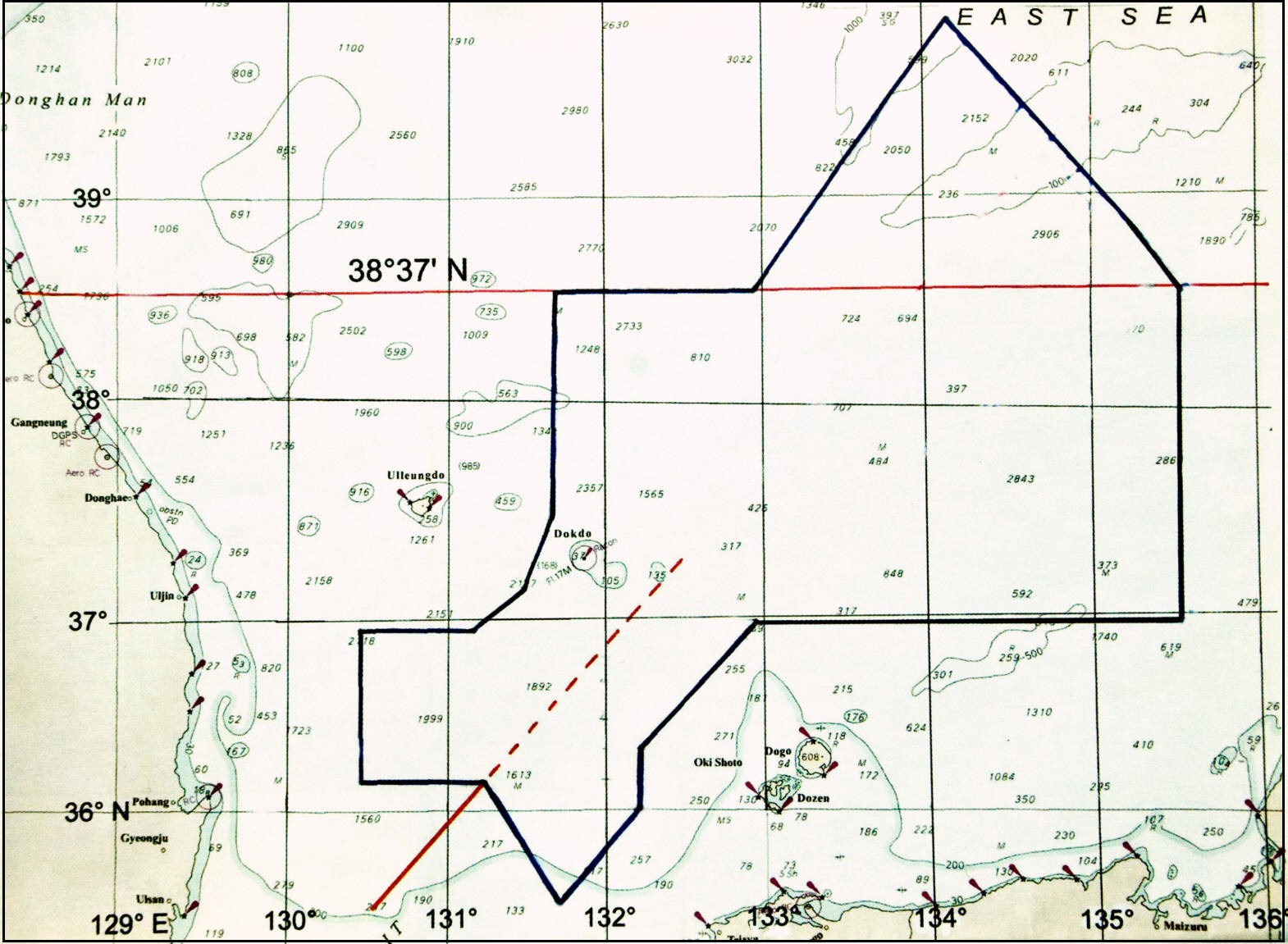
Anyways, here's the map over at the Economist:
And, here's a map that shows the area of the East Sea (Sea of Japan) that is disputed. 


(disputed waters in the East Sea/Sea of Japan)


Sunday, August 22, 2010

Unification Tax

edit: for clarity
 
August 15th is a good day to be in East Asia, unless well, you're in Japan, where it's a day of national humiliation; it's the day Japan surrendered. South Korean President Lee Myung Bak's proposed Unification Tax on August 15th was noteworthy in that it forward looking. It was announced on a day when usually there would be calls for Japan to apologize for deeds that occurred more than half a century ago.

I think the statement reflects better bilateral relations with Japan more so than it actually has anything to do with unification at all. By the way, I did find the statement pretty funny in the sense that it just completely ignores North Korea existing as an independent actor and speaks as if the country has already gone under -- which in a sense it has.

Link to KCNA statement via One Free Korea. There seems to be no link that posting...

Sunday, July 18, 2010

[Japan & Korea Missing Another Generation?] What does Apple's iOS and Google's Android OS mean for Japan and Korea?

edit: for clarity, 07/18

It seems every other day or so, there's some article that compares the sales of Apple iPhones with Apple's iOS to that of smart phones powered by Google's Android.

However, in phones, Google seems to have a winner on its hands. It will be hard for Apple to catch Android's numbers if the company can't even surpass their competitor's running weekly total at its yearly iPhone launch.
Anyways, I just ordered an iPhone 4 for my mother this past weekend and I'm sure in due time I'll have my hands one of my own as well -- preferably a white iPhone 4. And, no, white isn't a girl's color; it does require more maintenance though. But, anyways, as these articles continually compare sales, for some reason it reminds me of the original operating system war between Microsoft and Apple (and IBM among others) for personal computers. It seems Google is the Microsoft for phones this time around by commoditizing phones, whereas the Apple iOS is only on products with the Apple logo on it. (The best example here would be the Samsung Galaxy-S phone. The phone has the very same processoras that inside Apple's iPhone 4.)

But, unlike personal computers though, it seems the nice thing is that the apps for mobile platforms don't require all that much money to develop. So, regardless of which platform sells more the concern that my phone will become obsolete just isn't there. I guess this is something that is clearly in Apple's advantage as whereas Mac computer owners are stuck -- less so now than in years and decades before and particularly as Microsoft sells its Office productivity suite on Macs now -- with a much smaller choice of software, I doubt that the difference will be as noticeable if at all when Android powered phones inevitably leap frog Apple iPhone's in sales. So, as long as iPhones do keep selling, stories such as which phones powered by which platform really aren't that important with exception to the general trend that Microsoft's mobile platform seems to be dying.

What is interesting though is that once again it seems that Asian manufacturers are once again stuck manufacturing commodities again for another generation perhaps for perpetuity. Even if Microsoft's phone platform dies, Apple and Google seem to be marginalizing East Asian companies once again as chips, memory, LCD screens, flash memory, etc seem to just be nothing more than high tech commodities... I believe even Softbank -- the Japanese company that made a great deal of money by investing in Yahoo -- is profitting by selling iPhones in Japan. Of course, Research in Motion is Canadian and there's Symbian by Finland's Nokia.  

Japan and South Korea both had protected cell phone markets with super fast networks for quite some time now, but it seems the only types of companies that emerged to compete globally were hardware manufacturers. With exception to companies that catered to making cheap games and the like, where is the Japanese or Korean Apple or Google? Why isn't there one? It's all the more remarkable when considering that the United States has by far probably the most fragmented network -- competing CDMA and GSM networks -- deployed over an area that is very lightly populated compared with eitehr Europe or East Asia. With all the boasting about how consumers in Northeast Asia have for years been able to watch television or video chat on their phones, what has come of it?

Friday, June 4, 2010

[World Cup & North Korea] North Korea in a nutshell

This has got be one of the funniest things North Korea has ever done. North Korea will for the first time since 1966 make an appearance in the World Cup and has been put in the "Group of Death" with Brazil and Portugal Euro Cup champions Spain. (Yes, it is the NBA Finals right now, but the World Cup is about to begin shortly after the Lakers take care of the Celtics.) I've never counted gambling as one of my vices -- except when College Football season comes about, but, well, North Korea is just getting some terrible odds. Currently, the odds of North Korea winning the World Cup are set at 2000:1 -- or +200,000.

But, incredibly, it seems, well, North Korea tried to pack their final 23-man squad by only putting two real goalkeepers on the lineup and naming a forward as their third goalkeeper.

It is, though, a third Kim — Jong Hun, the North Korea coach — at whom the finger of suspicion was pointed yesterday because it was he who had named Kim Myong Won, the Amrokgang forward, as a third goalkeeper in his 23-strong squad. It would, Kim No 3 perhaps believed, give his tournament underdogs an extra option up front.

Fifa was not amused, pointing to its labyrinth of rules and regulations. “The three players listed as goalkeepers can only play as goalkeepers during the World Cup and cannot play outfield,” it said. “And Kim Myong Won will not be allowed to play as an outfield player if he has been put on the list as a goalkeeper.”
This development hasn't yet been factored into the odds yet as I don't know how many people would bet on North Korea, but let me tell you something. Joe indeed plans on putting down a nice, crisp, and, real (not a counterfeit) $20 on North Korea taking it all and probably another $20 for South Korea, who are being given a 250:1 (+25,000) shot at winning the World Cup. Of course, for some reason, the more technically proficient, higher ranked, and richer Japanese soccer team is being given a 600:1 shot. I am not putting down money on Japan, of course, which brings me to my next post. I'd like to put down money on the United States as well, but for a country that already considers herself to be the most powerful, richest, and technologically advanced nation in the world -- international sports doesn't really mean as much. The same doesn't hold for Japan, whose coach is aiming to make the semi-finals (what North Korea did in 1966 and South Korea did in 2002). South Korea is humbly hoping to make it the round of 16 -- the second round of the finals.

No, it's not that I like to donate money, but it's the fact that, well, I would want a Korean team to win. And, of course, if it's a only a dream I'd like to be compensated with some money as well -- it appears to be at least $40,000 if North Korea wins. But, anyways, North Korea trying to bend the rules -- and not use the rules in its favor -- seems to very much describe the rogue nation that is, well, North Korea or the DPRK.

Monday, May 17, 2010

Correction and commentary on U.S. Military Spending, Of Japan, the F-22

I earlier wrote that defense spending is roughly at 7% of U.S. GDP, but just googling it, puts it at 4.16% (including the two on-going wars) in 2008 and simply wikipedia-ing it shows that military spending shrank in absolute terms (along with the size of the economy) from 2008 to 2009. And, of course, 7% of about $13 trillion or so is about $900 billion (it's less than $700 billion), so that 4% figure looks right.

Note: I took the chart on the right from wikipedia, but I'm not a big fan of the other graphs that look at U.S. defense spending in terms of  per-capita spending on income defense in fixed U.S. dollars which does not take into account a richer U.S. economy (a better graph would be that as  % of GDP per year)...

U.S. military spending as a share of GDP does not at all seem that high (I think 7% would have been fairly close to historical peace time highs of the Reagan years, but 4% while we are still "fighting" two wars does not seem at all that bad), but I'd think it's unfair to criticize the level of military spending whether domestically or from an international perspective.

In fact, California has lost a lot of jobs because of reduced military spending back in the 90s -- (I believe) Southern California has traditionally had a hi-tech aerospace industry that had traditionally maintained a lot of high paying jobs -- until well Northman-Grumman formed (I believe the merger did away with the largest U.S. defense contractor headquartered in Southern California... And, on a side note, it's been a while since Los Angeles stood as the corporate headquarters for any major U.S. corporation --  the last major one to have been headquartered in L.A. was Atlantic Richfield Corporation (ARCO), which is now a part of good ol' BP or which was until recently known as British Petroleum).  

But, in the aggregate, the defense industry continues to be a huge exporter to the rest of the world. For example, Japan's airforce has nice F-15J's (I'm guessing J stands for Japan). And, South Korea has some nice, well, F-15K's (again, I'm guessing K stands for Korea). And, on a side note, I'd think it'd be a good idea to export those F-22s to Japan as the U.S. looks set to be unable to afford to build anymore F-22s unless, well, a rich Japan, which is eager to buy these planes, does indeed buy them and, of course, it'd be a nice way to "reward" the Japanese and re-affirm the U.S.-Japanese alliance while the U.S. doesn't have to close down the F-22 assembly line...

The current administration, which has done a fantastic job regarding North Korea (and South Korea, if they send Secretary of State Clinton within the next month or so and pass the KORUS FTA) , seems to be doing a rather feeble attempt to tell the Japanese how important they are to the United States (of course, not as feeble as the Japanese Prime Minister looked as he rather meekly explained the necessity of having U.S. troops stay in Okinawa). And, it looks like they are the only major country the U.S. would eventually be willing to sell the F-22 to and the only country with the means to purchase them).

But, anyways, the point is, well, I don't think military spending is at all too high and it ensures the U.S. will continue to be at the forefront of the sciences (e.g. the two national labs - Lawrence Livermore/Los Alamos that is behind the U.S. nuclear weapons program are managed by University of California -- well, at least, partially -- as a result of espionage by Chinese scientists at Los Alamos). In fact, if anything should be done, well, the U.S. should continue to encourage allies to spend more (e.g. Japan(~0.9% of GDP or so), South Korea (~3% of GDP is still not that high as, well, let' see North Korea spends about a quarter on defense)).  

Now, I think it's a bit unfair to criticize "rising" U.S. military spending, which when set as a moving average looks pretty constant as a share of GDP (3% to 4%) even as you leave in the two wars from 2000 to 2011 in the above graph (consider that the U.S. economy has been in recession during most of 2008-10). Moreover, that graph that I link to makes the U.S. spend a lot more than it does, but it should considered that the Chinese do not at all leave fully disclose their military spending).

Saturday, May 8, 2010

2010 and still the "Irish of Asia..."

It's been a really, really long time since a true European country dominated the seas and had dominion over much of the world, but yet there are writers out there, who continue to look at East Asia through a Eurocentric lens -- take this article in the NRO for example. Under the title, the author writes the caption:
On “the Irish of Asia,” premature technology, making friends with the family gun, and more(April Diary - John Derbyshire).
I mean what annoys me about an analogy like this is that why a country in East Asia cannot be considered in its own context. Why the misleading reference to Ireland even as a dated reference? The author goes so far as to say "the Irish squared?" Ireland in contrast was not so much about a country that was fought over for its strategic geography, but more so about finding herself to be next to a much, much bigger island. Additionally, the causes for the extreme nationalism that is found in East Asia have reasons -- particularly in Korea(and Japan, where it sits dormant at the moment, and China on a separate level), that are not at all common with the Irish or other European nations, but more so with each other -- extremely long history as a single people for starters.

By the way, I had the opportunity to visit Northern Ireland last summer and if there's anything forgotten about the forgotten war, I think I saw it. In front of Belfast City Hall, there was a memorial to the Irish that had fallen in the Korean War; I thought it highly tragic and (just a tad ironic) that this is the only place where the Irish could mourn for those that had fallen in a far flung war literally on the other side of the world as Irishmen and not soldiers fighting on behalf of Great Britain. I'm not sure if the Irish that did fight there were conscripted and if they had any idea why they were there, but they were -- but, I doubt they were thinking they were fighting in "Ireland."

But, nonetheless, to the core part of this posting. I mean it is 2010 and Korea has pretty much had the same borders with the same people more or less since the 7th centure CE though with different names across the times. And, yes, Korea has had a very tragic history in the past century and a half or so and past tragedies are still current in that they have yet to play out (the peninsula remains divided), but I do not think that it does justice to Korea (or to the fallen Irish or to the readers of that article) to consider the country in a manner that comes off so ...

Yes, Korea's modern history which begins in 1876 is all about foreign powers fighting over influence on the tiny peninsula (Ganghwa Treaty 1876, First Sino-Japanese War (1894-95), Russo-Japanese War (1904-05), Japanese Annexation (1910-1945), Second World War (1937-1945), and the  Korean War (1950-53)).

However, since that time half of the peninsula has come to host the Olympics (1988), co-hosted the World Cup (2002), and is set to hold the World Expo in 2012 -- maybe they'll build a new Eiffel tower then, who knows? Now, these are contemporary events that have happened in a single generation and I'm not referring to some obscure technological advancement or historical event that may have occurred first on the Korean Peninsula thousands or hundreds of years ago. Additionally, there's a good chance that the average Chinese-American or Taiwanese-American in at least California will have more as much  knowledge of Korean dramas, music, and movies as the than the average Korean-American. It is also a member of and is soon set to host the G-20 (for whatever that is worth) and also one of two Asian nations (yes, out of all of Asia)  that is a member of the OECD. Additionally, the country is the third largest source nation for international students in the United States (behind India and China). There's also a large Diaspora of Koreans in the United States (about 2m), China (another 2m), and Japan (<700,000). And, South Korea stands as the United States' seventh largest trading partner (ahead of all countries in the E.U. minus Germany and the United Kingdom). Additionally, Korea will also find herself to be overrepresented at the upcoming World Cup in South Africa with both North and South Korea playing there.

Finally, more people live in the Korean Peninsula (73 to 74 million people or so) than all of Great Britain and Ireland put together (yes, that's more than England, Scotland, Wales, Northern Ireland, and Ireland) or France or Italy or for that matter any European country aside from Germany and, perhaps, Turkey one day.

I think it's about time that this writer realizes that he is doing both a disservice to himself and gives the impression that he doesn't know what he's talking about when readers will most likely recognize Korea in its own context. It is, after all, 2010.

Friday, January 1, 2010

Of Malibu, 2010, and the puzzling dearth of Korean Nobel Laureates


It's 2010 and it's been twenty-two years since the Dodgers won the pennant, one hundred years since Japan annexed Korea (Joseon/Chosun/朝選), and ten years that I've had the right to vote. And, probably a a little more time than that since I've been to the Rose Parade in Pasadena (the Rose Parade's on TV right now). And, on a side note, it's interesting how there are probably as many floats from Chinese companies as there were from Japanese companies back when I went to the Rose Parades. My younger brother graduated from La Canada High School in La Canada-Flintridge, which would make a float for the parade each year. I attended the school for a semester as well and, well, it's a pretty big thing in that city. 

Anyways, I'm spending the first few days of 2010 at a beach house in Malibu with some close friends (No, the house isn't mine. Well, the owner of the house is actually a very, very wealthy friend of my friend's very wealthy mother). And, it is absolutely beautiful here though these pictures don't do it justice. Everyone is taking a stroll here on the beach and I'll join them soon, but I have a few remaining applications I have to or would like to work on. After all, it is 2010 and I don't want to start off the new decade being behind on my work.


But, to be honest, I have no idea if I'm really going to go onto graduate school this coming fall. I look at my grades and test scores and they're not too bad, but if I reflect back on the past ten years, then I start to worry if a school would really want an individual like myself at their graduate school. It seems like that's what's been on my mind every spare moment I have had for the past few months -- I've either been working on the statement of purpose, writing e-mails, or solving problems for an UG Real Analysis course.


However, I have been a volunteer at the English in Action program at the YWCA in Berkeley for the past couple years, where they match me with an individual, almost always Korean, who would like to practice speaking English on a one-on-one basis. Almost all my conversation partners, well those that I have cotninued to meet, up until this point have been usually Korean men around my age that are either doctoral candidates or post doctoral students at UC Berkeley. The interesting thing is every single time I talk to them they say that they can't study or do research in Korea. And, every single time I ask them, "why do you think that?"


And, the two usual answers I get are:
1. Almost all money invested in research is not in pure research, but applied research, where it's more about commercializing discoveries or trying to come up with ways to make money from contributions nationals from other countries have made.

And, probably, the most often heard answer are:
2. Research universities in Korea are very much like the country in which they are located in. Socializing and colloborating in research is done on a very a vertical basis, where it's socially difficult to criticize a senior faculty member.

So, a question naturally arises. South Korea is probably the most overrepresented country in research universities in the United States, but why is there not a single Korean Nobel Laureate? For example:

Worldwide, Seoul National University in Korea not only tops Harvard as the leading incubator of future U.S. economics PhDs but does so by a factor of more than two. During 1997–2002, 6 of the top 10 undergraduate alma maters of new U.S.-trained PhD economists were foreign universities—2 from South Korea and 1 each from China, India, Italy, and Taiwan. On average, 27 bachelor’s graduates of Seoul National Universityearn a PhD in economics from a U.S university each year, along with 7 from Yonsei University and 6 from Korea University, both also located in Seoul. Based on a dropout rate of 18.5 percent after two years of the Seoul National, Yonsei, and Korea University graduates who entered one of 27 American PhD programs in fall 2002 and assuming no further attrition among the group, an average annual graduating PhD class of 40 Seoul National, Yonsei, and Korea University alumni implies that at least 50 of their alumni enter U.S. economics PhD programs each year ("The Undergraduate Origins of PhD Economists" by John J. Siegfried and Wendy A. Stock).
But, at the same time, a Korean hasn't won a single Nobel Prize yet either, so, perhaps, my English Conversation Partners have a point -- though I hear there is a professor at UC Berkeley's Department of Chemistry that has a good chance to change that at some point. And, no, I don't consider former South Korean President Kim Dae Jung to be a legitimate Nobel Laureate. I believe he deserved it, but not for the reasons for which he was awarded for -- giving North Korea half a billion dollars. Anyways...

Monday, October 5, 2009

Forming Views on Korea, Part V: My family during Japanese rule.

So, finally, I've finally been able to take a world history course (The World Economy in the Twentieth Century or UC Berkeley's Econ 115). And, I blame this on myself, of course. I highly recommend that when you consider a double major, especially as a transfer student, to really consider if it's what you want to do. I've been unable to take many of the courses I might want to take, such as a history course, because of the requirements to complete both majors.

Anyways, I had a really interesting assignment for this class recently, where I was asked to write a short essay about where my family was from 1914-1945. And, I discovered a few things that I'd like to share and fits in perfectly with the discussion on how Koreans fared during the Japanese period.

You see, it seems to be the case that since all we ever hear about the colonial period is of how the Japanese drafted comfort women, moved around Korean laborers, and the like that we don't hear some of the benefits that were given to Koreans during this period (yes, I risk being shot here with these statements) to not people that were actually Japanese collaborators, but more so people who loved Korea, but where they found themselves to be born into a society where if they wanted to live a normal life like raising a family and such that they had to actually speak Japanese and learn Japanese (I can recall a conversation my mom had with her friends, where one of her friends said, "you remember when we were all young and our parents would start speaking in Japanese, and we'd have no idea what they were talking about..." This was a conversation in Korea by the way a few years back).

My claim is that Koreans are still unable to acknowledge that it was natural for some people to have benefitted under Japanese rule and that these people still loved Korea and the like (I'm thinking more along the lines of a Park Chung Hee than the founders of either Dong-a-Ilbo or Samsung), but the opportunities they had in life only existed if they accepted that Korea was for the time being a Japanese colony and that they realistically couldn't do a single thing about it. And, more so, and this is a claim purely along the lines of the early revisionists, such as Bruce Cumings, but it's really a matter of fact that when Korea became a Japanese colony, it opened up opportunities for Koreans that never existed before. It's this fact that these opportunities existed amidst the reality of a Japan trying to destroy Korean identity and alongsidethe widespread suffering of Koreans that makes this so difficult for Koreans to acknowledge. But, you have to understand that many during that period in time, including Koreans, believed Koreans were just incapable of self-rule (just think of how the Sino-Japanese War came about).

Anyways, I just found out that my grandfather served as one of the first senators before the National Assembly was built in Yeoido (when it was at the Blue House) when Rhee Syng Man came to power. And, I think his story or part of my story (as being the first son on my father's side) highlights #1) not all Koreans were hurt during the colonial period... #2)how this is still unable to be fully debated when Korea has not yet been unified.

(And, there's actually a typo here... It should say that Rhee Syng Man's administration faced constant questions of legitmacy not opportunities).

(I'm trying this embedded pdf thing for the first time, so if it doesn't work):


Click here:


Thursday, August 27, 2009

Shrimp among whales?

The reason that I brought up the population of these countries is not to suggest that Korea is a better country by any means, but to rid the common perception that Korea is not a "shrimp among whales" at all. It's just the very fact that Korea's neighbors are so monstrously large that lends credence to this misnomer.

Consider that among the countries neighboring the two Koreas that the next two smallest countries in terms of population--Japan and Russia both have well over a hundred million people. Of course, there are no equivalents in Europe (just assume Russia is not a part of Europe, which it really isn't in my opinion and who, according to most Russia observers these days, doesn't really care to be). Then, of course there's China.

What brings me to writing about this topic is that in the process of visiting the regions outside London, it's hard not to come across the feeling that this country isn't that large. What I mean by this is when I visited Wales, I could picture a lof of the people that were there would consider a visit to her capital as like a visit to the city. I mean, yes, I bet rural areas the world over, including those in the United States, would fall into a similar category, but just the ridiculously small scale at which this occurs in let's say not just parts of the U.K., but that of France, Spain, and probably Italy as well, reminded me of what I felt when I would come across people that have lived in Seoul their whole lives without visiting Busan even once and vice versa.

Perhaps, this is the norm in most parts of the world and countries such as the United States, China, or Russia are the exceptions. But, to me it shed the image of Korea being this really small country if countries, such as the United Kingdom, France, and Italy were, by nature, actually smaller than Korea. Of course, none of these countries borders a China, let alone a Japan.

Now consider South Korea's recent satellite launch from her own territory and North Korea's many "attempts" to put a satellite into orbit -- though I question whether there actually were more than dummy satellites in the North Korean missiles. It seems more than a tad ridiculous in my opinion that in South Korea's quest to attain respect and prestige somewhat akin to China, the country would be willing to expend vast sums to build a rocket when the country remains divided.

South Korea forgets that when most foreigners hear news of a rocket launch from South Korea, they hear the word South, before the word Korea at all.

Saturday, August 15, 2009

The past week...

I just started a week long backpacking trip in Europe. It began yesterday and I'm actually at an Internet Cafe in Paris waiting for the train station to open (By the way, I've noticed that Paris seems to be such a more lively city than its dead and limp counterpart in England). I have nothing, but praise for this city in the couple days I've been here except for the outrageous price for food and drinks. I'm comparing this experience with visits to Wales, Scotland (Glasgow and Edinburgh), and Northern Ireland (Belfast) over the course of living in London for the past month and a half.

There's a lot of things that I'd like to talk about it in the coming week, including:

Earlier on in this decade, during the height of the Sunshine Policy, many countries in Europe including the United Kingdom opened up diplomatic relations with North Korea with strong encouragement from the government in South Korea. So, on my last day in the U.K., I decided to go and visit the DPRK embassy. To my surprise, I found the resident ambassador to be quite accessible, even though I came after closing hours for the embassy and I left with some magazines. More on this later.

A visit to where the DPRK mission in France should have been.

I know Koreans and, perhaps, Americans, have this image that Korea is a very small country. But, if you think about it. It's not at all that small, depending on your definition of what constitutes a small country.

Consider that France, the United Kingdom, and Italy each have a population of about 60,000,000 with France having the largest number of people with 64,057,792(CIA World Factbook). Spain and Poland are each then att 35,000,000 or so.

So, if you think about it. Korea's not that small. And, I guess whenever Koreans use the excuse that we're a small country it's just not sound reasoning. So, on this basis, Korea isn't that small by any means. South Korea stands at some fifty million and, if unified, would outnumber all countries in the E.U. with the exception of Germany. I guess

Thursday, August 6, 2009

A post about something

The last couple posts were largely written from the perspective of me trying to put forth what I thought Clinton's summit meant now and what it could mean in the future. But, for today's post -- and I'm trying very hard to refrain from posting for the sake of posting, I'm going to have to criticize probably the worst editorial I've come across in a long time and try to undo the disservice to the American public that the New York Times has just done. It's definitely worse than the fairly recent editorial from the Los Angeles Times on which I had so much to say. This is just an excerpt:
To start, that means not giving in to Pyongyang’s desire to make the talks a bilateral process with Washington. It is imperative to keep South Korea, Japan, China and Russia — key participants in any effective deal — engaged. Officials from Washington and Pyongyang can still meet separately, as they did under Mr. Bush.

Most important, the United States and its partners need to make clear that the expectations are higher than they were before — that North Korea will not be rewarded again just for recommitting to promises that were broken before and likely will be broken again. Future steps toward disarmament must be irreversible.

Under a 2005 agreement, North Korea shut down its reactor at Yongbyon — the source of plutonium for its nuclear weapons — and promised to dismantle its bomb-making infrastructure. It has since kicked out international inspectors and claims to be rebuilding and resuming its capabilities. One way to make disablement more permanent: pour concrete into the reactor core ("Next Steps With North Korea" : New York Times).
I thought George W. Bush's Administration was out of touch with reality when during the entire time North Korea systematically went from first withdrawing from the NPT and then kicking out inspectors at Yongbyon to eventually detonating a nuclear device, the only thing the Bush Administration actually did was mutter ridiculously delusional demands, such as "CVID" (Complete, Verifiable, Irreversible, Disarmament).

But, this article. This article reminds me of those translated to English, Neoconfucian classics on what it takes to be a good leader or a good king or like a saying from Sun Tzu's Art of War. It throws basically everything a wise and virtuous leader should do (basically mention anything and everything that could be written down without expressing a coherent opinion and, of course, all the while conveniently not mentioning any explicit course of action a good and virtuous leader should actually do). It might make for great philosophy -- if you're into that kind of thing, but it sure shouldn't be wasting space on a major U.S. daily.

What got me in particular was how the author doesn't take a position on the six-party talks. North Korea feels betrayed (China is a permanent member on the U.N.S.C. and they recently passed sanctions against North Korea). So, of course, North Korea doesn't want to go to Beijing for Six-Party Talks. And, the U.S. has rejected bilateral talks with North Korea. And, President Obama is saying nothing has changed:
In words that may well serve to reassure U.S. allies Japan and South Korea, Gibbs said U.S. policy had not changed as a result of Clinton's visit ("White House says policy toward North Korea unchanged" : Reuters India).
So, I would think that this article would have a new suggestion linking back to something from Clintons' trip that has somehow allowed for some new type of dialogue (which it doesn't do) or argue for something that's been proposed in the past (which it also doesn't do).

In an editorial one would expect a stance toward a particular issue and would take the time to outline it. For example, I think it's about time to let the six party talks die, perhaps in favor of four-party talks (and not necessarily in Beijing either). There are just too many countries representing too many interests, which makes the entire process too cumbersome. It also rewards Beijing for doing absolutely nothing, while giving the U.S. the false impression and hope that Beijing actually has the influence to reign in North Korea from developing nukes, when the country clearly doesn't.

Moreover, what does the author mean when writing that the United States must keep her allies "engaged" even as the United States and North Korea can meet without the presence of her allies. I mean what type of "engagement" are we talking about.

President Obama's "engagement" -- which is more like George W. Bush Administration's CVID talk were it ever to have been implemented into policy one day? Or, how Japan was being engaged when the U.S. notified her closest ally in Asia some twenty minutes before taking North Korea off its list of states sponsoring terrorism? (Recall that North Korea kidnapped Japanese citizens from Japanese soil -- imagine the outcry if that happened in California -- which is similar to the warcry that gave us California -- and, of course, North Korea actually harbored Japanese communist terrorist/rebels; This is similar to the Bush Administration's accusations against Tehran early on in this decade if these accusations actually turned out to be true). By the way, I really am a Republican (in a more traditional sense, if you get what I mean).

But anyways, back to this work of profound thought. The author writes, "Future steps toward disarmament must be irreversible." Umm. There's more to this sentence than just stating the obvious and moving towards the asinine. "One way to make disablement more permanent: pour concrete into the reactor core."

Anyways, the reason I bring this up is that this article for all it's gibberish gives off the illusion that people still believe that North Korea will give up it's nuclear weapons in exchange for aid one day. And, this is exactly what this trashy editorial (can't believe it was actually published in the New York Times) presumes: North Korea will give up its nukes. And, one thing that the past sixteen years has shown...Why else would the Obama Administration be "engaging" North Korea in a way that has changed the definition of the word "engagement" (something this reporter just doesn't seem to get).

Sixteen years of North Korean intransigence has now shown both those that had been previously in favor of "engagement" (Sunshine Policy people, what the word used to mean when previously used in context of North Korea) with North Korea and those that didn't are now all basically in agreement -- North Korea will not give up it's nuclear weapons (But let's say for the sake of this article, that it's possible. North Korea will willingly give up its nukes -- as the country borders China, South Korea, and Russia). This time though, let's make it permanent: "One way to make disablement more permanent: pour concrete into the reactor core."

Wednesday, August 5, 2009

What to expect from Clinton's "Summit"

And, Kim Jong Il Gets What He Wants... (Which is ? Scroll to the way bottom)
While former President Clinton goes to North Korea (as an unoffical guest, which is quite convenient for the U.S.), Kim Jong Il finally gets his one-on-one encounter with a (former, Democratic) U.S. president -- before he dies. It made all the headlines here in the U.K. as well, however I couldn't find an equivalent of the one they had at over at the Economist. I nabbed the picture below from "North Korea: Pictures from an exhibition" : The Economist.


At any rate, North Korean leader Kim Jong Il finally got the attention he so craved. While reading one of the U.K. dailies today, I came across this one part, which I thought was quite funny. These are insults that have been traded between the U.S. and the North Korean regime at one point or another:

Kim Jong-il may have been all smiles and handshakes with Bill, but just a few days ago his regime was in something of a slanging match with the other Clinton.

On a recent visit to New Delhi, Hillary, the Secretary of State, bemoaned the North Korean leadership's "constant demand for attention," before adding: "Maybe it's the mother in me or the experience that I've had with small children and unruly teenagers."

The North Koreans' response was firm. "We cannot but regard Mrs Clinton as a funny lady as she likes to utter such rhetoric, unaware of the elementary etiquette in the international community," a spokesperson said. "Sometimes she looks like a primary schoolgirl and sometimes like a pensioner going shopping."

The name-calling between Washington and Pyongyang is not new. George W Bush branded Kim Jong-il "a spoiled child at a dinner table". The North Koreans called Bush a "tyrannical imbecile" lacking "even an iota of elementary reason". And in 1968, North Korea's Major-General Pak Chung Kuk called Lyndon Johnson a "living corpse" ("Two U.S. journalists freed from Korean gulag" : The Independent).
At any rate, there was a lot of press coverage, but with expectations suddenly raised between North Korea and the U.S., although I feel I am a quite an optimist by nature, I cannot be more than a tad pessimistic about what may lay ahead. This "summit" has all the elements that the Koizumi-Kim summit had in 2002 when Koizumi suddenly and unexpectedly arrived in North Korea for a summit with North Korean leader Kim Jong Il for the release of Japanese abductees. Of course, none at the time and nobody more so than former Japanese Prime Minister Koizumi could have anticipated how adversely the Japanese public would consume the news that their citizens had indeed been abducted.

Personally, I believe what will drive North Korea-U.S. relations as well as with the other four parties from the six party framework, is how each party comes to accept the fact that North Korea will never give up its nuclear weapons. This stands in stark and direct conflict with the fact that the United States will never accept North Korea as a legitimate nuclear power along the lines that the U.S. has with India -- and rightly so.

But, I do believe the U.S. would be content to see a steady-state where North Korea has nuclear weapons, but doesn't share/sell nuclear weapons or technology to other countries or non-state actors. Of course, this would hinge on North Korea not testing nuclear weapons (you can see this as the U.S. -- I'm thinking Department of Defense here, which has a different definition as to what constitutes a nuclear test than the U.S. State Department). And, of course, this action by the U.S. would in and of itself be a security guarantee for North Korea -- while not directly in the form of an alliance, the U.S. will do everything in its power to make sure a state with nuclear weapons does not collapse (think Pakistan).

But, pessimissm aside, I have a feeling that come one year -- and provided Kim Jong Il doesn't die, not much will have changed from how things were perhaps a couple years ago. If North Korea returns to a posture where it looks like it is going to negotiate, then South Korea can again start trading with North Korea and, well, unfortunately Japan looks like the odd man out (I'm quite concerned about what would happen if Japan's interests were not considered by the U.S., leading to Japan re-arming. Japan has quite a few greivances with all her neighbors: Kuril Islands/lack of peace treaty (Russia), Liancourt Rocks (Korea), No Peace Treaty (North Korea), and the Senkaku Islands (China/Republic of China(Taiwan)). I'm probably missing some others as well.

Anyways, I'm thinking that at best we can expect a return to the status quo and see what type of vocabulary each country uses to come up with a tacit acceptance of North Korea's nuclear weapons program as no country will go to war with North Korea to get rid of it.

(So, Kim Jong Il gets a de-facto security guarantee from the United States with the potential for much more).

Monday, July 27, 2009

Of Textbooks and Computer Games

Oh, and by the way this brings me to a post about the ridiculous system of English education in Korea. Again, I don't think I'll ever be able to get over how English is taught before Sino-Korean Characters(한자, 漢字)!. You see, I don’t understand why there aren’t specific books made for the Korean market. (maybe there were or are now, but I haven’t come across them…).

I remember one thing that I hated and I guess this is a double edged sword in that I hated how large the Korean computer gaming market was. You see when I lived in Korea I loved playing computer games (now, I just like to buy the game and see how good the graphics look on my computer, show it off to a couple people who could care less, and then end up selling it in a couple months) … But, I swear just as certain Korean grandparents can play Go (바둑) at that age; I’m going to playing Civilization X or at least show off to my grandchildren how nice the graphics are...

Well, anyways, the problem with the Korean computer gaming market being so big (and I believe the online gaming market was the largest in the world before World of Warcraft and broadband Internet – by the way, should this word still be capitalized really took off in the rest of the world?

Anyways, the Korean computer gaming market being “big” is all nice if you’re a Korean-Korean or a native Korean since this means companies such as Electronic Arts will invest the time and money to localize the game (as in at the very least translate the game into Korean). But, for people like me, well, …

You see, I always loved the game Civilization. When I was in Korea, Civilization 3 came out and that’s when I learned what the word 문명 (*civilization*) meant. It was nice; all the menus were in Korean and all, and while I could understand what “Install” was or “Options” was in Korean, when it came to actually playing the game and moving these "historical units," I was quite frustrated … (Of course, for Korea it was a boon, I mean this was the beginning of Korean cultural or media exports that were no longer about building gigantic ships that no other country asides from either a China or Japan has desire to build, but finally songs, computer games, television dramas, movies, etc…)

But anyways, for me, it wasn’t that great. At least, for playing “문명” (Civilization, if you don’t have a Korean font installed). But, you see, as an English teacher there I saw a parallel. The funny thing is that you would think that Korea would have the largest market for books teaching Koreans English from a Korean perspective. But, I cannot tell you how many times I came across expensive, no, very expensive textbooks published by large American or British companies that were published to teach the domestic market (Americans or the British) English. In America, the last time I studied grammar – and I’m not sure if this is true for rest of America, but the last time I studied grammar was I believe in fifth or sixth grade.

I remember the teacher correcting us if we wrote I would of rather than I would’ve

You see, that’s a problem that native English speakers of Americans have when learning how to write in English and not one that Koreans would have.

If these game companies can localize games for the large domestic market in Korea, then these gigantic publishing houses should do the same for these ESL books (Of course, they might exist already, but textbooks not localized for the domestic Korean market should not be allowed into the market as they do a great disservice to those trying to learn and teach English).
Please excuse my generalizations, but please do understand that I’m speaking about a wide and I mean a wide range of topics in this blog).

Sunday, July 26, 2009

A Schizophrenic Han

(Probably Part I of II) Part II can be found here.
From previous posts, such as this one, you can tell I am somewhat sympathetic towards Lee Myung Bak. He just seems to be the wrong president at the wrong time, but anyways I just read this article and every single time I read something like this, the political situation in Korea boggles the mind (But on a side note, I'd also argue that South Korea is one of just two East Asian countries with democratic institutions - Taiwan being the other one. And Japan, well, we'll see). That is, how on earth can people care so vehemently (and violently) about civil rights on the margin when there's North Korea just a fiften minute drive away (of course, it's not really about civil rights. It seems to be more about getting even in my opinion).

But anyways, how can those in Korea (those few that care about politics that is, which in and of itself is amazing -- Considering that half the country still remains divided, the country is still just yet another middle income country, the country is at WAR and has been for half a century) care so little about politics.

How Can This Go On In Korea?
"Now the former president’s supporters are blockading the halls of parliament 24 hours a day, preventing deputies from getting into the chamber and any laws from being passed (see picture). Progressives are demanding the president apologise for Mr Roh’s suicide, claiming that prosecutors who were investigating him were operating at Mr Lee’s behest—a charge the president furiously denies" ("Political confrontation in South Korea: Long, hot summer" Economist)
To take a look at how ridiculous this is, we need to briefly examine Korean history (When Koreans often proudly claim a 5,000 year history, they are referring back to 2333 BCE as the beginning of the Korean People. Koreans not unlike that of Israelis do not distinguish ethnicity from nationality -- although recent trends in South Korea seem to be breaking from tradition among many others, including teaching English before Sino-Korean Characters).

It doesn't make sense to me that there's a country that has pretty much had the same borders and unified borders since the 7th century can care so much about the freedom of the press at the margin when half of the country will -- I honestly believe -- go down in history as the worst example of a totalitarian government that systematically implements human rights violations (perputating ignorance is just as big a human rights violation in my honest opinion as physical torture -- think fascism -- and here North Korea has no parallels).

By the way, on a tangent here, for those Koreans, who believe in this newly created North-South States Period Theory or 남북국시대 (신라+발해 = Korea), let me tell you -- it's pure rubbish, which I would like to address in detail one day(The main question behind that issue comes down to who were the Mohe (말갈, 靺鞨) people. What is uncontested is that the people that lived under Balhae were not the same as that lived under Silla).

But anyways, what is important here is how it is undisputedable that there has been a Korean state since the 7th century. Yet, after about 1300 years as one united (한 나라), half the country comes to be moderately wealthy after a relatively, short period of immense humiliation (36 years out of 5000?) and destitution (is there a precedent in Korean history, where Korea was like an island before? Because, South Korea right now surely resembles an island state like a large Singapore).

To get to the heart of the matter, it's hard to take complaints against the current Lee Myung Bak president seriously when these same people can condone what's going on in the northern half of the peninsula, yet be so vehemently be against alleged human rights violations against the Lee Myung Bak administration that if true would lay on the margins.

Freedom of press violations? (This is where I would say perpetuating ignorance is also a crime against humanity" c'mon Americans only eat Australian beef? Anyways, yes, it looks like Lee Myung Bak is trying to limit some of the gains made by the (State run) news organizations, but still... it pales in comparison to the North.

Are Koreans Schizophrenic? How on Earth can you look at a country when there's a shared history -- imagine, let's say, a thousand years of a country with no minorities. No sense of other. I mean, in the United States, there were Indians, and then the Irish and Germans and then the Latins, etc etc... But, in Korea, there was the Kim clan and Lee clan (of course, gets more detailed) than that and, yes, the Chang clan...
While, half their fellow bretheren -- half of the clan members are just having the time of their lives under Kim Jong Il, freedom of the press is so important or an apology that important or necessary? Does it serve any function other than to ask for the current South Korean president to belittle himself?

Monday, July 20, 2009

The Power Of Words Part II and of a Korean War Memorial... in Northern Ireland

This past weekend I was in Belfast, Ireland on what I'd like to say was an epic adventure. While I was enjoying the sight of:


I came across this:


If you can't see the words, this is what it says:

"IN MEMORY OF

the Officers and Men

of

THE 1st BATTALION

THE ROYAL ULSTER RIFLES

Who lost their lives

in

KOREA

and especially those were killed

under(?) this place

on

3rd - 4th January 1951."

Here I was in a rather small capital of Northern Ireland, which is still and probably always will be a part of the United Kingdom --an opinion of which I don't have. But anyways, it's a city hall! And, on the grounds of this city hall (it's a small city with a population of some 267,500 according to the NISRA), there's a memorial that dedicates the lives of those that fought and died in Korea nearly sixty years ago.

All because of the words of one man -- Harry Truman (who single handedly decided to intervene in the Korean War; again, I can't remember where I read it, but there was a declassified CIA document that an article cited that even had if Soviet spies had access to all CIA information at the time, they would've discovered that nobody in the CIA establishment would've believed the U.S. would fight a war in Korea). So, it was basically Harry Truman, who singlehandley decided that there would be this memorial to the dead on the grounds of a city hall in Belfast!

And, especially, at the behest of the United States, and one man at that -- who got the United Kingdom, got these British -- no, these Irishmen to go and fight halfway across the world. They went all the way to the Far East -- in Korea (Where?). Anyways, I guess what makes this so particularly sad is the thought: is there no better place to pay respects to the fallen Irish soldiers (without calling them British) than on the grounds of a city hall?!

You see I had no idea any Irishmen fought in the Korean War or the Coalition of the Willing 1950s version, but to me it strikes a parallel with those Koreans who fought for the Japanese Empire during World War II. The sad thing is that these Irish who fought on behalf of the United Kingdom, who then fought on behalf of the United Nations by request of the United States doesn't even get proper recognition.

"British casualties were 1,078 killed in action, 2,674 wounded and 1,060 missing or taken prisoner" ("The Korean War: An Overview" : BBC).

Or, the first Korean, who won a gold medal at the Olympics, but had to do so as a "Japanese citizen" or the first "Japanese" graduate of Stanford who couldn't use his Korean name. Not quite sure how I went from the Korean War to Stanford to the Olympics, but anyways... That's what I felt when I saw that yesterday morning.

Monday, July 13, 2009

China and Another Bankrupt Ideology

All the spare time recently has gone to sightseeing, studying, and just the general process of being overseas and stuff, so I haven't had an opportunity to update this blog. And, the stuff I did want to write about was about the trees here, or the awkward signs, or the language, or the castles, or the villages, you know some of the more pleasent stuff in life -- but the outrageous way in which Turks in Xinjiang(新疆, 신강) have been treated should be recognized as a serious threat to both the United States and Korea for we can now see Communist China for who she really is and why we as responsible citizens should care.

What Does It Mean To Be Chinese?

You see the Chinese flag has five stars. Each of the five stars represents an ethnic group that is supposed to compose the Chinese nation. These five stars represent the Han Chinese, the Turks of Xinjiang, Tibetans, Manchurians, and Mongolians. I was in fact referring to the older flag of the KMT (the pro-mainland party in Taiwan) during 1912-1928:
"五族共和" (Five ethnic groups together in harmony) -- Thank you Gudong.
Nonetheless, it is still indeed the ideology of the current communist regime in China that ethnicity has nothing do with nationality (Hence, Tibetans are Chinese according to this thought).
The ideology is so that just like you have Chinese-Americans in the United States, you have a Chinese nation of multiple ethnic groups, including Koreans. But, they don't get a star (But, of course, the crucial difference would be that Chinese-Americans willingly migrated to the United States whereas those five groups outside of Manchurians, who for all practical purposes no longer exist as a distinct ethnic group, were either physically conquered and/or culturally assimilated by the Han).

This should be of particular importance to Koreans as this was the main reason given by the Chinese government as to why the Chinese government claims Goguryeo as a kingdom in Northeast China as a minority Chinese kingdom. The logic being that since China is not a nation of a single ethnic group -- as in an Israel or Korea -- then it is possible for those people of Goguryeo or even Koreans to be ethnically Korean, but their nationality to be Chinese.

Of course, with uprisings in Tibet last year (and comparisons with Native Americans by Han Chinese) and Xinjiang this year, we all now know that just like communism, this concept or ideology of Chinese nationality is, well, bankrupt. China is a nation of Han Chinese who are systematically taking advantage of her ethnic minorities and continuing a ten-thousand year history of absorbing smaller, neighboring countries and ethnic groups one-by-one. Interestingly, the first character, "Xin" (新,신), Xinjiang, represents new as if it's some new land for the Chinese to settle.

This process of conquest and assimilation is not just a communist thing, you see. The Republic of China (Taiwan), even claims what is left of Mongolia. And, this I believe is more of a Chinese thing. This has been going on for hundreds and hundreds, no thousands, of years (Think about the initial assimilation of the Cantonese civilization). But, the easiest way to look at it is by looking at something none other than where the Great Wall of China is.

You see, for most of history, well, up until 1644 (when the barbarians conquered China for good), the Great Wall was meant to protect civilization (China) from the uncivilized or not as civilized (the rest of the world, pretty much). China was pretty much "contained" to the east coast with tributary states to the northeast (Korea, Japan) and to the south (Dai Viet, though, this state was directly ruled by the Chinese as late as during the Ming period), but did at times directly rule over states in the west. Nonetheless, even as late as the 19th century, when Manchurian rulers finally allowed the Han to settle in Manchuria (those areas northeast of the Great Wall), most of Manchuria was scarcely populated and the region was devoid of Han Chinese, which certainly is not the case today. Much of the lands that were occupied by barbarians are now part of China proper and the barbarians there speak Mandarin.

I remember a few years ago the term that China kept using was the "peaceful rise of China" or so, as if, to tell the world that you know what, the middle kingdom -- literally (中國), is returning to it's proper place as the center of the world and will do so in a very peaceful way. By the way, I'm sorry to tell you Sinophiles out there, but I doubt this will ever happen again, for you see, the United States is now here and by geography and ideology (and, perhaps, even destiny) the country sits right in the middle -- between the West and the Far East.

The last time the Han Chinese tried to conquer Korea (7th century C.E.) when the Tang turned on Silla, the Tang were much bigger than Silla, but nowhere near the proportions that either one of the Koreas today faces (This is one of the reasons why
I believe North Korea has a nuclear weapons program and why I believe a unified Korea will need either a nuclear weapons program or an iron tight alliance with the United States for perpetuity). Do you think Korea could have survived up until today had the Chinese borders been like how it is today for the past couple thousand years?

I'm not disputing the territorial claims that Communist China makes with respect to Tibet nor Xinjiang (though Taiwan is a whole another matter, but that's for another day), but I'm pretty sure nobody believes the Chinese government's definition of what it means to be Chinese now.