Sunday, December 19, 2010

I like the Internet so much because...Are the Korean and Mongolian languages related and, if so, how?

edit: 12/20 for clarity
edit: 12/21 corrected dates of regarding King Sejong's rule...
I haven't posted in a while as I've been and am being treated for falling from a wall I was trying to climb. I like to think I'm like superman at times and I guess this has been another episode, albeit one unlike any other in my life. In treatment, I haven't had an Internet connection and during this time I've arrived at an answer to the question, why do I like the Internet so much? to answer the question of why I like the Internet so much.

In this blog, I feel I have an outlet, where I can express my views and opinions on issues or events going around in this world that in the absence of this blog, I feel I otherwise would not have. I mostly write about issues that I feel strongly about. I usually relate it to my own personal life experiences either in school or not. Sometimes, I write about what I feel I like to share. At other times, I find myself too busy to write anything at all or with nothing I'd like to share.
But, this only accounts for a fraction of what attracts me to the Internet. At the hospital, I've come to feel very lucky when a newspaper became available to me. However, gaining access to a newspaper has also made me wish I still had access to not just a single newspaper, but to the ability to read or search for articles amongst thousands of newspapers, publications, and blogs via the Internet. These feelings have shown up after I got injured thinking I was Superman. I tried climbing up a wall and fell down.

A time when I really felt like Superman was during my summer vacation in 2009 in in guess where and where... ? ^^


I don't quite remember the source, but a few years ago I remember reading -- perhaps it was when the Wikipedia was first introduced -- the claim that Korean and Mongolian are some how related to each other. I believe Korean as a language not unlike  the Japanese language is traditionally classified as not belonging to a branch of languages, such as Altaic. One of the nurses that I have met during my recovery has been a Mongolian immigrant to California. I told her about this claim and how one of the examples had been how saying the "right side" in Korean and Mongolian are almost homonyms.

In Korean, one form of saying right side happens to be "Ba-reun-jjok" -- it's not my computer here so I can't access the Korean written language, which by the way had been invented under the rule of King Sejong the Great, who happens to be a great grandfather dating back to the 15th century CE on my mother's side and a reason why I tell my brother he needs to become more fluent in Korean. For more details, maternally, the creator of the lineage happens to be none other than King Sejong the Great's ninth son.

According to the Mongolian nurse, right side in Mongolian happens to be none other than "Ba-rrohn" (with a rolling r here).

Another claim of the paper had been that the Korean dish Bulgogi or Beef was a descendant of, well, guess what, "Mongolian Beef." I wish I had Internet access as I need to get going now.

Friday, November 26, 2010

Thanksgiving

rough draft Oct/27/10
edit: Dec/21/10 - corrected link to previous post criticizing Aiden Foster-Carter's paper...

After receiving surgery a couple weeks ago, I've been in a hospital with another surgery being scheduled for one in another couple weeks. As my stay  has continued to grow longer, the stay has proved to be quite positive in the sense of recovering from surgery. At the same time though, I've noticed the hospital also functions as a shield in that it has kept me from reading news articles (no Internet) or watching televised news articles. (no television in rooms). However, I've been approached a couple times about the possibility of war breaking due to the recent North Korean attack on a South Korean controlled island.This has out in Korea and it has drawn me to write this post in the nurses computers as I try to compute what the possibility of war will be.

 To get an understanding of why North Korea has done this, it's important not to forget that North Korea has named Kim Jong Il's youngest son in a position of authority. With Kim Jong Il still, alive, the possibility of war is zero and the most recent action to attack South Koreans functions to display how weak the North Korean-Chinese alliance is.

In this context, North Korea attacked South Korean forces largely to illustrate that even with Kim Jong Il's terrible health, North Korea is still run by a powerful, centralized government. This is a highly important issue when looking for the primary goals for North Korea deciding to attack South Koreans.

I earlier wrote against the principle that China won a prize by having North Korean support and it seems China is losing more than it gains by "allying" with North Korea.

The Economist has a recent article that binds the recent DPRK attack within this context of China actually losing out by North Koean agression:

China cannot be blind to the Kims’ bungling and bellicosity, nor welcome their nuclear ambitions. But it has had two worse fears. One is of a rekindled war on the peninsula, which would damage China. The other is of North Korean collapse, with millions of desperate refugees pouring into China and South Korea or even American troops on China’s border. It is as a bulwark against this “instability” that China cossets the Kims. It refused to condemn them even for the sinking of the Cheonan, and this week issued blandly even-handed calls for restraint. It apparently believes that if their only ally abandons them, the Kims might do something really rash.
To assess the value of this action by North Korea, all we need to do is consider that the purpose of these attacks are to suggest that even when Kim Jong Il passes away, the government is strong and led by his brother-in-law/sister, and his 27 year old son. News coverage that asks the average joe what the chances of war will be after the North Korean attack is proves to a positive consequence for North Korea attacking South Korea.Of course, if the average joe answers that chances of war are still almost zero, then the miliary attack happened to be a failure for all countries in the region.

p.s. I've been very sick for the past couple months and I've been unable to post on this webblog until, well, I was driven to post on this topic. But, me being sick, does not get me to start concluding that there will be war in Northeast Asia. It does hint that future elections will be won by SKorean politicians siting to the right of center - GNP/Han Nara Dang)


After North Korean artillery showered this island in the Yellow Sea Tuesday, locals say they're fearful of North Korea's latest threats of a peninsula 'on the brink of war.'

Police officers patrol near houses destroyed by a North Korean attack on the Yeonpyeong Island, South Korea, Friday. Yeonpyeong is evacuating its 1,700 residents after North Korea said they were on the 'brink of war.'
(rough draft )

Monday, September 20, 2010

Gwanghwamun Restoration

Robert Koehler:
After a lengthy restoration process, Gwanghwamun Gate — the main entrance of Gyeongbokgung Palace and a major downtown landmark — was finally unveiled to the public yesterday, the Liberation Day holiday.

The Cultural Heritage Administration brought in some heavy hitters for the restoration, including calligraphic engraving master Oh Ok-jin (Important Intangible Cultural Property No. 106) to paint the signboard and dancheong master Yang Yong-ho to paint the superstructure. For those of you wondering, dancheong is the colorful painted designs found on many of Korea’s historic wooden public building — not only is it decorative, but it also protected the wood from the elements.

Gwanghwamun Gate has had a tumultuous contemporary history, making it something of a microcosm of Korea’s contemporary history as a whole. The gate was first constructed in 1395, making it — along with the rest of Gyeongbokgung Palace — one of the first buildings constructed in the new royal capital of Seoul. Also like the rest of the palace, it was burnt down during the Japanese invasion of 1592, and left in ruins until Heungseon Daewongun‘s grand restoration of the palace in 1867.

Then things started to get funky. In 1910, Japan annexed Korea. In 1926, the Japanese — great preservationists of Korea’s cultural heritage that they were — had Gwanghwamun Gate torn down and moved to the east side of the palace, all so it wouldn’t restrict the view of the massive Japanese Government-General Building (demolished in 1996), which they had oh-so-sensitively placed right in front of Gyeongbokgung Palace, blocking the view the historic palace from downtown Seoul. The demolition of the gate sparked protests from not only Koreans, but also from Japanese intellectuals, most notably Yanagi Sōetsu, the founder of Japan’s Craft Art movement and an admirer of Korean traditional art.

[...]
Still noticeable is the decision to reverse the Chinese script on the gate from left-to-right to right-to-left as it had historically been. I guess this is the ever existing problem of translation, whether a strict, literal interpretation is better than a more liberal interpretation. In this case, I think it looks funny. Modern Korean when written horizontally doesn't read from right to left. 

Doubts about "How North Korea was lost - to China"

Add/Update: For clarity. Sept. 20th, '10

There's an interesting article here that looks at how Seoul and Washington "lost" North Korea;  I don't find it very agreeable

Aiden Foster-Carter has written an long piece in the Asia Times on North Korea’s geopolitics.  It is a fairly long piece, so here is the punch line:
So there’s our winner. Its rivals’ missteps have helped, but Beijing has long played a skillful, patient game. Like Moscow, it irked the North by recognizing South Korea (in 1992), but unlike the abrupt Russians it worked hard to soothe sensitivities.
Eighteen years on, guess which power is the top trade partner of both Koreas? Now, there’s subtle hegemony for you. No prizes either for guessing who’s snapping up North Korea’s mines, and beginning the lengthy, costly process of modernizing its decrepit infrastructure.
Face it: who else has the motive, or the means? As all agree, China’s overriding worry about North Korea is not Kim’s nukes but fear of collapse, and the chaos this could cause on its own borders. Beijing’s consistent strategy is not to paint Kim into a corner, no matter what.
Knowing that, how did policymakers in Seoul or Washington delude themselves that China would hurry to join a chorus of condemnation over the Cheonan? No way. Beijing squirmed a bit, but the game was worth the candle. Let Washington and Seoul huff and puff. All that achieved was to push an ever-more isolated North Korea further into China’s orbit and influence.
Nothing is certain, especially about North Korea where forecasts (this writer’s not least) have a habit of turning out wrong. I expected North Korea to collapse long ago: guilty as charged, m’lud. I understimated this tough regime’s staying power, or the horrors it would impose on its people – including famine – to cling to power while refusing to see sense.
But this can’t go on forever. The old game of militant mendicancy is finally up. Kim Jong-il’s frail health, a delicate succession, and an empty treasury – United Nations sanctions have hit arms exports, and crime doesn’t pay like it used to – make defying the entire world just too risky.
North Korea needs a sugar daddy. There is only one candidate left standing, and one who fits the bill perfectly. It may not be a marriage made in heaven, mind you. Pyongyang will keep squawking, and even try the old game of playing off its interlocutors – as in its latest thaw with Seoul.
But at the end of the day Beijing is making an offer no one else can match, and which North Korea can’t refuse. It goes roughly like this: Okay, we’ll bail you out, we’ll guarantee your security, we’ll even stomach your weird monarchical tendencies – unless the kid turns out to be a complete klutz, in which case you know what to do. Jang Song-taek (brother-in-law to Kim Jong-il) knows the score.
You can count on us too not to shame you by spelling all this out and giving the game away. But yes, we do need something in return. Two things. First: markets. For goodness sake just leave them alone, nay let ‘em rip – as we’ve been telling you to, ever since Deng Xiaoping.
Look where we are now, and where you are. We’ll do the heavy lifting of investment, so you have functioning factories and railways again. But you have to let it happen. No going back.
Second: no more trouble. We know it may take time for you to give up your footling pesky nukes. But we need an absolute guarantee of no more tests, or else. No other provocations, either. Our People’s Liberation Army will teach your Korean People’s Army how to adapt and how to make money. The new North Korea will be a good global citizen, trading like we do. The returns are good. It beats mugging any day.
And guess what? You’ll love it, all of you. You’ll prosper. No more worries. Your people will eat; your elite will make money. What’s not to like? Just stop all that shouting and marching; what a relief, eh? The rest of the cult can stay, if you must. All hail the young general Kim Jong-eun, finally fulfilling grandpa’s dream of peace and prosperity for all! (With a bit of help from his friends, but we’re modest.) You’ll love him. You really will.
This seems to me a plausible scenario for North Korea’s future. In fact, I struggle to imagine any other. Korean reunification? Maybe in the very long run – but right now, who wants it?
Not the North, whose elite know the fate of their East German counterparts after unification. Can we really expect them to put their faith in the tender mercies of Lee Myung-bak? Even under Kim Dae-jung or Roh Moo-hyun it would have been tricky. What place would there be for most of them, frankly, in a reunified peninsula? Not a privileged one, that’s for sure.
Ordinary North Koreans, too, have learned, from the trickle who have made it to Seoul, that South Korea is no land of milk and honey. True, they’d like a life, and to eat. But China, or a North Korea open to and learning from China, might look a better bet on that score.
Nor is the South enthusiastic, despite all the rhetoric. It would be embarrassing and galling to see the North become a Chinese satellite – yet perhaps also a huge relief. Let Beijing bear the brunt, the burden, and the costs of transforming the madhouse they have long sustained.
Further down the line, blood could prove thicker. By 2040 or so, a by then semi-transformed North Korea may tire of great Han chauvinism, slough off the Chinese yoke, and embrace the cousins south of the demilitarized zone (which would long ago have become more permeable). They’d be easier to absorb, too, now smoothed by a few decades of Chinese-style modernity.
Speculative, to be sure. But what other scenarios are there? And though from one viewpoint China has edged out rival powers as argued above, presumably to their chagrin, might some of them in truth be quietly relieved to be spared the responsibility?
Let China take it on and deliver a new-style North Korea, vibrant and fit for a new century. It could last a long time, and spare the region and world much headache and risk. Does anyone have an alternative?
Aidan Foster-Carter is honorary senior research fellow in sociology and modern Korea at Leeds University, and a freelance consultant, writer and broadcaster on Korean affairs. A regular visitor to the peninsula, he has followed North Korea for over 40 years.
In its entirety, Aidan Foster-Carter writes:
Knowing that, how did policymakers in Seoul or Washington delude themselves that China would hurry to join a chorus of condemnation over the Cheonan? No way. Beijing squirmed a bit, but the game was worth the candle. Let Washington and Seoul huff and puff. All that achieved was to push an ever-more isolated North Korea further into China's orbit and influence.
I mean just as much as China likes to make deals with military juntas -- primarily North Korea and Burma,
"But at the end of the day Beijing is making an offer no one else can match, and which North Korea can't refuse."
I think Washington and Seoul expected, well, more from China. 

But, what I'd like to ask is why is China settling on North Korea when the country should be eying South Korea? In the past few months, China has basically pushed Vietnam, South Korea, and, now, Japan to the arms of, well, the United States. 

It's not as if China  has just won a strategic competition against other countries for the great prize that is North Korea. Rather -- and I think many (e.g. Scott Snyder) have argued that this is how North Koreans see it as well. It is not the case of a calculating China defeating the U.S. and the other countries in some grand chess game for influence in North Korea, but rather just a simple case of China looking to gratify its own immediate desire -- "Chinese stability."

Consider that as a result of the Cheonan fiasco -- from none other than a Sinocentric point of view --  the huge cost for China has been South Korea. I would think the ultimate end game for China  -- again from a Sinocentric point of view -- is to dominate East Asia, which includes kicking out or splintering the U.S.-Japan and U.S-ROK alliances and unifying with Taiwan. The end game for China is not about paying for North Korean food, roads, and ports and extracting natural resources that North Korea may have. The real gold is elsewhere.

I'd bet that North Korea surely sees this too and would love at any cost to get the United States to guarantee the security of the country any day over the Chinese. In the meantime, China will continue to feed North Korea, build North Korean roads and ports, and bring the northern half of the peninsula out of the dark ages all of which North Korea will not be grateful for. After all, China is doing this for self-serving reasons.

Add:

This is the logic behind why despite China's growing economic clout over the Korean peninsula  -- China is also Japan's number one trade partner, this has not translated over into political clout.  I  think that this type of reasoning underlying the original article could come to only feed the doubt of those that think South Korea and the United States have become too confrontational with North Korea and think that perhaps reverting back to some form of the now bankrupt Sunshine Policy  may not be that bad of an idea.


Andrew Lankov:
A senior South Korean diplomat described this problem in a private conversation by a good allegory: "China does not have leverage when it comes to dealing with the North. What China has is a hammer."
I would also recommend Scott Snyder's China's Rise and the Two Koreas: Politics, Economics, Security here.

Sunday, September 19, 2010

There seems to be a problem with the Economist's Map...

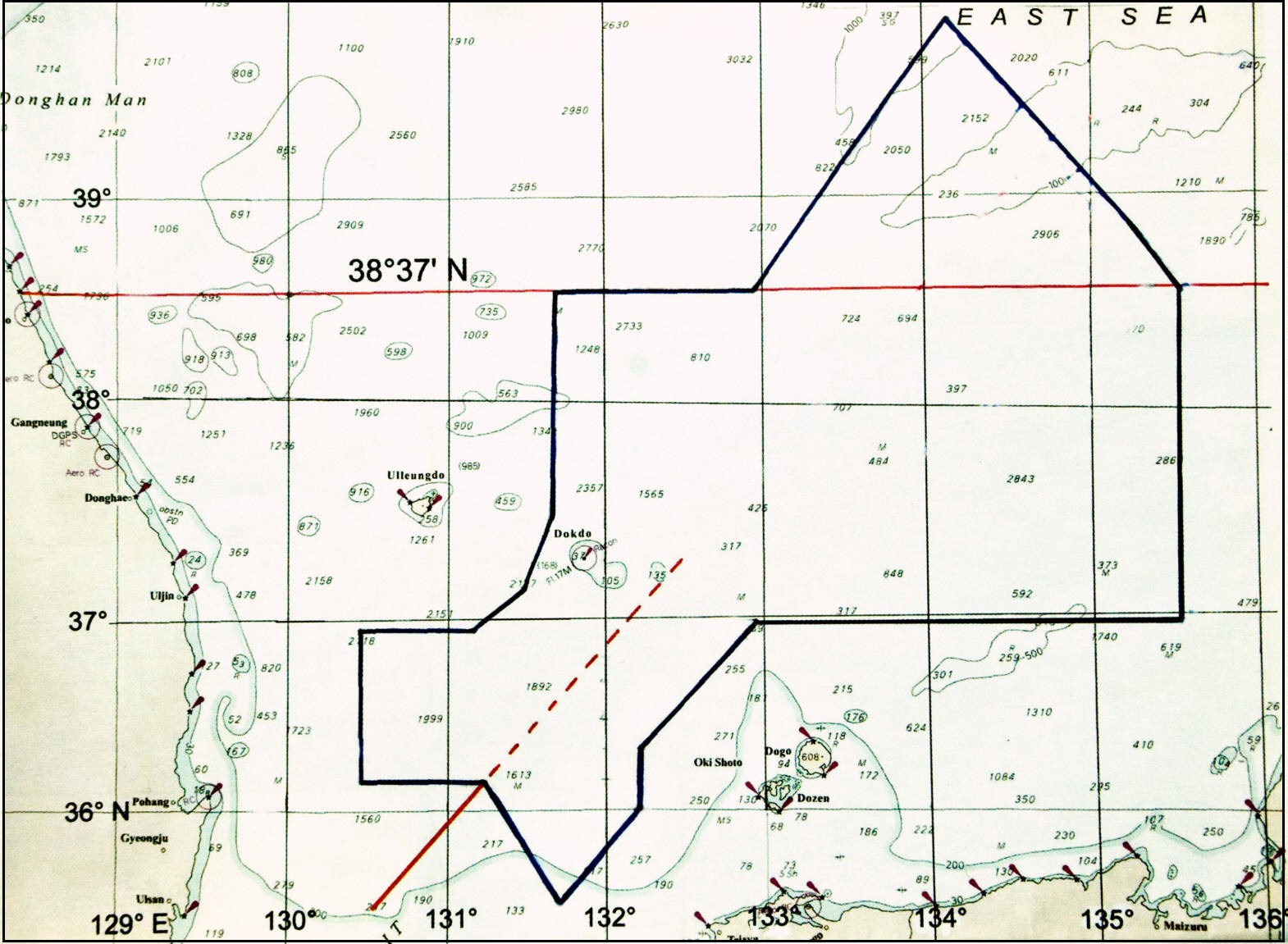
In an article outlining heightened tensions between China and Japan (again), the map on the article by the Economist seems to label the Liancourt Rocks (Dokdo/Takeshima) as part of Japanese territory or being part of Japan's exclusive economic zone. The Senkaku/Diaoyu island chains are demarcated as such, whereas the Kuril Islands -- including the lower two --  are marked as Russian territory. So, it's a bit puzzling that the Liancourt Rocks are labeled to be a part of Japan. Clearly this is a matter of grave concern as, well, heaven forbid if fifty years later Japanese -- or for that matter any nationalist "historian"-- were to say, look here, we found an old map by the Economist clearly showing that Takeshima is a part of Japan.

And, by the way, a quick look at the second map shows exactly why the Liancourt Rocks seem to be so important. It takes up such a huge chunk of the seas east of the Korean peninsula.

Anyways, here's the map over at the Economist:
And, here's a map that shows the area of the East Sea (Sea of Japan) that is disputed. 


(disputed waters in the East Sea/Sea of Japan)


Thursday, September 16, 2010

[U.S. Capitulation to the Chinese] Japanese Currency Intervention

For the first time since 2004...

Economist's Free Exchange:

AMONG today's big news items is the word that Japan is now actively selling yen in order to improve its exchange rate against other major currencies. The yen has risen sharply in recent months, dealing a blow to Japanese exporters and slowing Japanese recovery.
The columnist looks at the development in a positive light.
Doom and gloom, but I feel more positive about this development. Consider Buttonwood's take:
As David Bloom of HSBC points out in a note responding to the move, the costs of intervention to the Japanese are not great. Selling yen and buying dollars results in more yen being created, which might be inflationary, but a bit of Japanese inflation wouild be a good thing.
My thought concerns the general tendency of countries to want their currencies to depreciate. Everyone would like to boost their growth by letting their currencies slide and increasing exports. Of course, not all can succeed. Someone must increase net imports and let their currency appreciate. The obvious candidate is the Chinese, but they are unwilling to let it happen (at least at a pace desired by the rest of the world).
The result is like a game of deflationary pass the parcel in which the countries with appreciating currencies eventually feel the pressure, and try to reverse the trend.
But, I wonder if this development is in fact simply the realization that China will not fairly value its currency -- irrespective of what this may or may not do with respect to the U.S. trade deficit -- and that rather than waiting for a time that will not come, Japan has decided the country could wait no longer.

Consider the South Korean Won. South Korean exports compete directly with many Japanese exports, and South Korean exporters have historically looked at a 10 KRW : 1 JPY ratio as the level where South Korean exports would still remain competitive with Japanese exports. However, this changed in 2008 as the South Korean Won collapsed. (Its performance was the second worst that year after, well, Iceland's currency.) Since that time, rather than the South Korean Won tracking the performance of the Japanese Yen -- which it historically has, the currency now seems to be tracking the performance of, well, the Chinese Yuan. Until the just announced Yen Intervention, the currencies have been trading at about 14 KRW : 1 JPY. (The link to a chart is here.) The story seems to be the same with respect to the New Taiwanese Dollar (TWD). (The link to a chart is here.)

So, doesn't it seem to be the case that the Japanese have decided that the expense of waiting for the Chinese to revalue is just too great? In this sense, it's hard to be optimistic when it seems to be a capitulation on the part of the U.S. to Chinese mercantile practices, which in the process seems to have dragged the rest of East Asia along with Beijing. What will it take before the U.S. "takes action"? (By the way, in this sense, I miss President George W. Bush. His ability to "take decisive action" -- whatever the costs or logic may be -- seems to be ostensibly missing right now. (I think with respect to defense issues I'm a huge supporter of current U.S. policy of re-engaging the East Asia region, but I think this would be there regardless of who is in power. e.g. Consider the Guam naval buildup since 2006.)

Sunday, September 12, 2010

Senkaku/Diaoyu Islands

Recently, it appears that Japan has taken into custody Chinese fishermen in disputed waters as Japan and both Chinas all claim a string of islands called the Senkaku (Diaoyu) Islands. The funny thing about these islands is that, well, after the Second World War -- or the second Sino-Japanese War -- they were first occupied by Americans not unlike the Liancourt Rocks (Dokdo/Takeshima), which Japan and both Koreas also claim as their own. This is East Asia...

I understand that North Korea and much of the rest of the world likes to say that Americans are a crazy nation that likes war, but I find it interesting in what America did with the "islands" when they were under U.S. control -- both became places that American planes would bomb. 

Anyways, Japan has recently released most of the fishermen except for its captain as, well...


The fishing boat reportedly rammed Japanese coast guard patrol boats which had been trying to intercept it.
And, in another example of Beijing's respect for her East Asian neighbors, BBC News also reports:

On Sunday Chinese diplomat State Councillor Dai Bingguo warned Tokyo to make a "wise political decision" over the matter.
and
The Chinese foreign ministry said any evidence collected by Japan on the collision would be "illegal, invalid and in vain".
Of course, it's interesting to see this considering recent naval exercises in the region by the United States Navy and, of course, the magnanimous decision of the U.S. to facilitate territorial disputes between China and Vietnam. Maybe, the talks, if they ever materialize, could also include the Philippines, the other China (Taiwan), and maybe Japan as well, to make for new round(s) of six party talks. I'm sure they would have a better chance at arriving at a solution than those talks held in Beijing or even those talks of having the talks in the first place.