Showing posts with label 남북국시대. Show all posts

Sunday, February 28, 2010

[DeCal] *Edited* Review - Korean History: 2333 BCE to 1876 CE

As promised, Leah Yi and Tori Bazz's presentation and review of Korean History: 2333 BCE to 1876 CE can be found here. And, all presentations that are available online can be found by scrolling down on the right hand side.

Remember, the point of this course is not to dwell on history, but to use it as a tool to better understand contemporary events. With this in mind, names of figures or even names of kingdoms become rather irrelevant then. Naturally, then what is clear from our understanding of Korean history is this:

The borders of Korea have more or less remain unchanged since the unification of Korea by Silla in the 7th century CE and there have been no significant movement or immigration to the peninsula (until perhaps the last decade or so) since the fall of the last Han commandery called Lolang in 313 CE. Thus, Korea has had a single group of people - more or less (for more, I mentioned the Korean Haplogroup - O2b, which is present in a significant number of males on the Korean peninsula and the Japanese peninsula, but absent among China's population), who have come to speak the same language over the course of 1,300 years.

Note that France was united around the first decade of the sixteenth century (I believe), Spain - 1492, Germany & Italy - 1870, Russia - I believe some time in between - I think most of what is Russia today was occupied by remnants of the Golden Horde (or Mongols) until the 16th or 17th centuries... So, you can imagine why Korea could be so nationalistic and so xenophobic (not a single minority ethnic group). I believe Korea and Japan are the only two countries, where you'll find almost no ethnic Chinese communities in significant numbers in all of East Asia. Up until recently, I believe there were 50,000 ethnic Chinese out of a population of almost 50 million (about 0.1%).

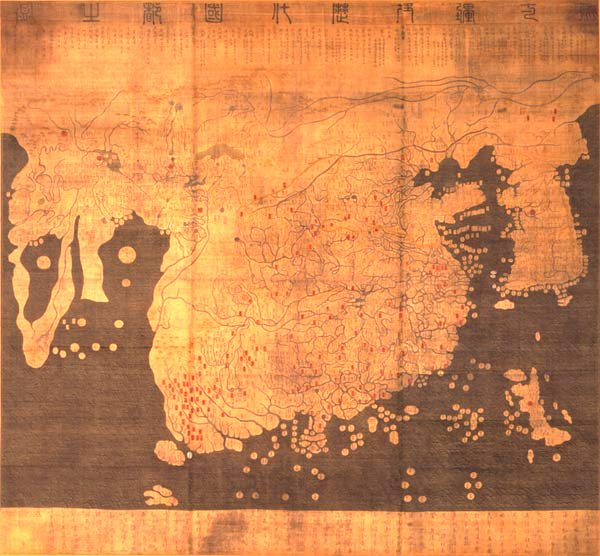
In this context, the issue of whether these kingdoms, such as Goguryeo (高句麗) or Balhae (渤海) were "Korean" are rather unimportant and, perhaps, even irrelevant next to how it is the merger of the separate kingdoms' people and culture (for more: check out Samhan/Buyeo, 三韓/夫餘 - in Sino-Korean/扶餘 - in traditional Chinese script) that gave rise to the singular identity of a Korean people. This is probably the most important theme to take from ancient Korean history (along with the geography of the Korean peninsula and the geographical location of the Korean peninsula). Also, I mentioned the Gangnido Map (and how it has a really long name. Wikipedia cites the term, "Honil Gangni Yeokdae Gukdo Jido ("Map of Integrated Lands and Regions of Historical Countries and Capitals", 혼일강리역대국도지도, 混一疆理歷代國都之圖) for the map. Nonetheless, it is an easy and quick way to visualize how Koreans saw themselves in relation to the outside world during the Joseon dynasty.  

Also, as discussed in class, I claimed that the North South States Period (남북국시대, 南北國時代) is a recent construct as it refers to a time when Silla (then Goryeo) controlled the bottom two thirds of the peninsula, but the rest was controlled by first Goguryeo (then Balhae) and the origins of the theory come from works during the mid Joseon period about a millenia later in the book Samguk Yusa (三國遺事). I also mentioned how this is used by modern (South) Korean scholars to justify the division of the Korean Peninsula.

Also, the name of the last Korean kingdom was touched upon and how it refers to North Koreans today in both the Koreas, all the Chinese languages and Japan. Perhaps, it's best understood by the Sino-Korean characters (or traditional -- classical? -- Chinese script): North Korean (Joseon Person (朝鮮人)) vs South Korean (Hanguk Person (韓國人)). Actually on second though, In South Korea, 朝鮮人 would probably refer to somebody from the Joseon Dynasty and the term 朝鮮族 would refer to ethnic Korean-Chinese (that have lived in China since around 1880. For more, See A Comparison of the Korean Minorities in China and Japan by Pyong, Gap Min). In both North and South Korea, they would just add the term South or North in front of their word for Korea. So, the term for North Korean would just be North (Hanguk Person) in South  Korea, while the term for South Koreans would just be South (Joseon Person) in North Korea.
 
Interestingly, in China the latter term was not used until after normalization of ties with South Korea. The term Hanguk actually derives from the period 1897-1905, when the Joseon dynasty fully joined the Westphalian (Western/Modern) International Order and which we have not yet discussed -- when it was no longer considered a vassal state after the first Sino-Japanese War (Became, the Great Empire of the Han People (not to be confused with the term Han used for Han Chinese (漢) vs Han (韓) Koreans)). On a side note, this is precisely the reason why classical Chinese characters are important as in both the Korean and Japanese languages there are a large number of homonyms that can't be described by words constructed from an alphabet (this is precisely why Kanji (literally Chinese Script or Sino-Japanese characters) are still in heavy usage in Japan and many (should) be in usage in the Koreas today...I believe -- there are 5 vowels in the Japanese language and no differences made through pitch. Korean is much the same except with a larger number of vowels and for the most part a single pitch as well).

 The historical connection between the Joseon Dynasty (the Hermit Kingdom, Land of the Morning Calm) and North Korea becomes very straight forward when thought in this light (and as we shall see over the rest of the semester).

Saturday, September 26, 2009

A Schizophrenic Han - Part II (Revised & Amended)

There is something seriously wrong with the psyche of Korean people.
I wrote Part I, some time ago, here: "A Schizophrenic Han". But, a couple articles caught my eye and, so, here I am writing Part II.

"Next year will be the year when we will put in order what had happened in the past 100 years. We need to work on building a new 100 years of Japan-South Korea relations," Okada said.

The Japanese government has yet to respond to South Korean President Lee Myung-bak's invitation to Japanese Emperor Akihito, the foreign minister said.

"We have not any decision as of yet," he said. "It should be carefully considered, as the emperor's visit to South Korea should be politically neutral"("No bilateral talks with N. Korea without nuclear solution: Japanese FM" : Yonhap News).
I think it's far too early to have the Japanese Emperor visit Korea. Yes, next year will mark a century since the date when Korea became a Japanese colony, but it will also mark a century since Korea had been last  unified. Anyways, the real problem is this. South Korea really wants to believe everything is okay and that there is nothing wrong with the way things currently are. For example, South Korean teams in international sporting now compete as part of the Korea, Republic (or Korea, Rep. of)rather than Republic of Korea or South Korea to the image (to both herself and the rest of the world in my opinon) that the team really does represent all of Korea.

It's not hard to sense the irony in this statement then:
"The new Japanese government has the courage to face up to history.'' These words ― uttered by Prime Minister Yukio Hatoyama during a summit with President Lee Myung-bak Wednesday ― were what all Asian neighbors have long wanted to hear from Japan (New Dawn in Asia : Korea Times).
(Japan recently witnessed a new government and saw a new political party sweep into power not unlike what happened in Mexico in 2000). And, the writer of that editorial in the Korea Times thinks it's very important that Japan, apologize, for crimes committed in her history, a tired theme that just won't go away in relations between South Korea and Japan. I think it's about time that the Korean government finds the courage to face up to history. I think it's also about time that people in South Korea (the South Korean people as a word just doesn't seem like the right word here) accept the perverse reality that is North Korea today and to accept that the ultimate responsibility of unifying Korea lies in the hands of not Americans or Japanese or other foreign powers, but with Koreans.

And, most importantly, and not just with respect to unification, but I strongly feel that it is about time that Koreans should have the confidence to accept that it is ultimately the responsibility of Koreans to see what is happening to other Koreans in North Korea and to do something about it(rather than debating what the definition of Koreans means today or depending largely on Japanese media for news on North Korea).

While the words of Korean President Lee Myung Bak have taken a rather bellicose theme lately, don't let those words fool you. The administration's policy still reflects a country in denial still operating under the banner of a Don't Let North Korea Fail At All Costs Policy. The Yonhap article writes
South Korean President Lee Myung-bak earlier this week proposed a package deal in which the five other parties would provide the North with security guarantees, massive economic aid and other incentives in return for complete denuclearization, necessitating no further negotiations.
Nothing really has changed and nothing really will change unless all of South Korea actually comes to accept that the country is first and foremost still divided and that rather than expending resources on such trivial things as the hosting of the G-20 summit, realize that South Korea definitely has the ability and means to unify the country if she wants to. For example, how old does the cold war seem today when you actually sit down and consider that a South Korean national serves as the current Secretary-General of the United Nations.

You could also look at what South Korean historians are doing. Historians in South Korea put weight, as I've pointed out earlier (in Part I), on theories now that would otherwise be of little relevance were it to not the case that Korea still remains divided today. Specifically, the North-South States Period (남북국시대) serves mainly to justify the division of the peninsula in the mind of Koreans and to make it seem as if the division is entirely natural (since it happened before and the country eventually unified) and that it's perfectly alright to think of other things for the moment (such as leading your life and forgetting that your second cousin or a cousin twice removed is doing time as a slave laborer).

I wonder if the Japanese public ever thinks, "you know what, I bet you anything that life was better for most Koreans in North Korea when they were ruled by us." This was, of course, one of the justifications by the Japanese for colonizing Korea a century ago. Past and present South Korean governments with an apathetic South Korean constituency and along with all the other apathetic Koreans of other flavors, such as Korean-Chinese, Korean-Americans, and the like, are just as much accomplices by choosing ignorance in this debate(tragedy). Choosing ignorance like that which is forced upon North Koreans, who are also citizens of the Republic of Korea or, who are, also, by definition and Constitution, part of the Nation of the Great Han People (literal translation of the official name of South Korea, 한민국, 韓民國) does not seem Great at all.

I fail to see how a Great People can let half her People live under constant torture and come up with all sorts of excuses and, yet, still claim to be Great. And, no, I don't believe I know what the South Korean government should do (nor do I believe that there is an easy way towards Unification), but what I do believe would be a tangible, first step is to accept that what is currently the state of things in Korea is unnatural, not normal, and that pleading either ignorance or apathy is immoral. Accepting that Koreans are ultimately responsible for themselves should be a given for a Great People.

Sunday, July 26, 2009

A Schizophrenic Han

(Probably Part I of II) Part II can be found here.
From previous posts, such as this one, you can tell I am somewhat sympathetic towards Lee Myung Bak. He just seems to be the wrong president at the wrong time, but anyways I just read this article and every single time I read something like this, the political situation in Korea boggles the mind (But on a side note, I'd also argue that South Korea is one of just two East Asian countries with democratic institutions - Taiwan being the other one. And Japan, well, we'll see). That is, how on earth can people care so vehemently (and violently) about civil rights on the margin when there's North Korea just a fiften minute drive away (of course, it's not really about civil rights. It seems to be more about getting even in my opinion).

But anyways, how can those in Korea (those few that care about politics that is, which in and of itself is amazing -- Considering that half the country still remains divided, the country is still just yet another middle income country, the country is at WAR and has been for half a century) care so little about politics.

How Can This Go On In Korea?
"Now the former president’s supporters are blockading the halls of parliament 24 hours a day, preventing deputies from getting into the chamber and any laws from being passed (see picture). Progressives are demanding the president apologise for Mr Roh’s suicide, claiming that prosecutors who were investigating him were operating at Mr Lee’s behest—a charge the president furiously denies" ("Political confrontation in South Korea: Long, hot summer" Economist)
To take a look at how ridiculous this is, we need to briefly examine Korean history (When Koreans often proudly claim a 5,000 year history, they are referring back to 2333 BCE as the beginning of the Korean People. Koreans not unlike that of Israelis do not distinguish ethnicity from nationality -- although recent trends in South Korea seem to be breaking from tradition among many others, including teaching English before Sino-Korean Characters).

It doesn't make sense to me that there's a country that has pretty much had the same borders and unified borders since the 7th century can care so much about the freedom of the press at the margin when half of the country will -- I honestly believe -- go down in history as the worst example of a totalitarian government that systematically implements human rights violations (perputating ignorance is just as big a human rights violation in my honest opinion as physical torture -- think fascism -- and here North Korea has no parallels).

By the way, on a tangent here, for those Koreans, who believe in this newly created North-South States Period Theory or 남북국시대 (신라+발해 = Korea), let me tell you -- it's pure rubbish, which I would like to address in detail one day(The main question behind that issue comes down to who were the Mohe (말갈, 靺鞨) people. What is uncontested is that the people that lived under Balhae were not the same as that lived under Silla).

But anyways, what is important here is how it is undisputedable that there has been a Korean state since the 7th century. Yet, after about 1300 years as one united (한 나라), half the country comes to be moderately wealthy after a relatively, short period of immense humiliation (36 years out of 5000?) and destitution (is there a precedent in Korean history, where Korea was like an island before? Because, South Korea right now surely resembles an island state like a large Singapore).

To get to the heart of the matter, it's hard to take complaints against the current Lee Myung Bak president seriously when these same people can condone what's going on in the northern half of the peninsula, yet be so vehemently be against alleged human rights violations against the Lee Myung Bak administration that if true would lay on the margins.

Freedom of press violations? (This is where I would say perpetuating ignorance is also a crime against humanity" c'mon Americans only eat Australian beef? Anyways, yes, it looks like Lee Myung Bak is trying to limit some of the gains made by the (State run) news organizations, but still... it pales in comparison to the North.

Are Koreans Schizophrenic? How on Earth can you look at a country when there's a shared history -- imagine, let's say, a thousand years of a country with no minorities. No sense of other. I mean, in the United States, there were Indians, and then the Irish and Germans and then the Latins, etc etc... But, in Korea, there was the Kim clan and Lee clan (of course, gets more detailed) than that and, yes, the Chang clan...
While, half their fellow bretheren -- half of the clan members are just having the time of their lives under Kim Jong Il, freedom of the press is so important or an apology that important or necessary? Does it serve any function other than to ask for the current South Korean president to belittle himself?