As promised, Leah Yi and Tori Bazz's presentation and review of Korean History: 2333 BCE to 1876 CE can be found here. And, all presentations that are available online can be found by scrolling down on the right hand side.
Remember, the point of this course is not to dwell on history, but to use it as a tool to better understand contemporary events. With this in mind, names of figures or even names of kingdoms become rather irrelevant then. Naturally, then what is clear from our understanding of Korean history is this:
The borders of Korea have more or less remain unchanged since the unification of Korea by Silla in the 7th century CE and there have been no significant movement or immigration to the peninsula (until perhaps the last decade or so) since the fall of the last Han commandery called Lolang in 313 CE. Thus, Korea has had a single group of people - more or less (for more, I mentioned the Korean Haplogroup - O2b, which is present in a significant number of males on the Korean peninsula and the Japanese peninsula, but absent among China's population), who have come to speak the same language over the course of 1,300 years.
Note that France was united around the first decade of the sixteenth century (I believe), Spain - 1492, Germany & Italy - 1870, Russia - I believe some time in between - I think most of what is Russia today was occupied by remnants of the Golden Horde (or Mongols) until the 16th or 17th centuries... So, you can imagine why Korea could be so nationalistic and so xenophobic (not a single minority ethnic group). I believe Korea and Japan are the only two countries, where you'll find almost no ethnic Chinese communities in significant numbers in all of East Asia. Up until recently, I believe there were 50,000 ethnic Chinese out of a population of almost 50 million (about 0.1%).
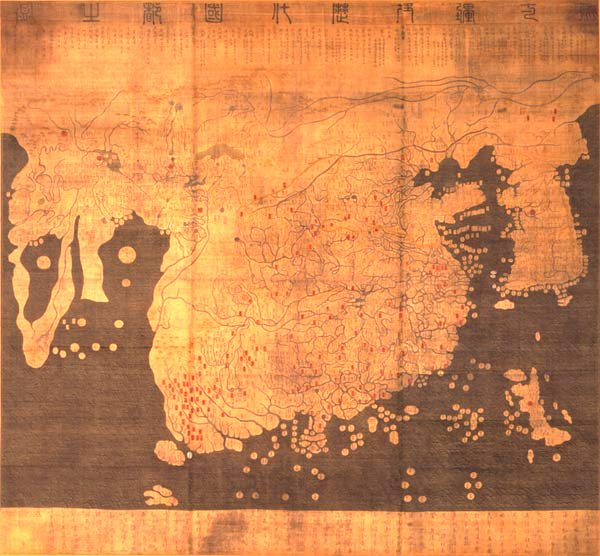
In this context, the issue of whether these kingdoms, such as Goguryeo (高句麗) or Balhae (渤海) were "Korean" are rather unimportant and, perhaps, even irrelevant next to how it is the merger of the separate kingdoms' people and culture (for more: check out Samhan/Buyeo, 三韓/夫餘 - in Sino-Korean/扶餘 - in traditional Chinese script) that gave rise to the singular identity of a Korean people. This is probably the most important theme to take from ancient Korean history (along with the geography of the Korean peninsula and the geographical location of the Korean peninsula). Also, I mentioned the Gangnido Map (and how it has a really long name. Wikipedia cites the term, "Honil Gangni Yeokdae Gukdo Jido ("Map of Integrated Lands and Regions of Historical Countries and Capitals", 혼일강리역대국도지도, 混一疆理歷代國都之圖) for the map. Nonetheless, it is an easy and quick way to visualize how Koreans saw themselves in relation to the outside world during the Joseon dynasty.
Note that France was united around the first decade of the sixteenth century (I believe), Spain - 1492, Germany & Italy - 1870, Russia - I believe some time in between - I think most of what is Russia today was occupied by remnants of the Golden Horde (or Mongols) until the 16th or 17th centuries... So, you can imagine why Korea could be so nationalistic and so xenophobic (not a single minority ethnic group). I believe Korea and Japan are the only two countries, where you'll find almost no ethnic Chinese communities in significant numbers in all of East Asia. Up until recently, I believe there were 50,000 ethnic Chinese out of a population of almost 50 million (about 0.1%).
In this context, the issue of whether these kingdoms, such as Goguryeo (高句麗) or Balhae (渤海) were "Korean" are rather unimportant and, perhaps, even irrelevant next to how it is the merger of the separate kingdoms' people and culture (for more: check out Samhan/Buyeo, 三韓/夫餘 - in Sino-Korean/扶餘 - in traditional Chinese script) that gave rise to the singular identity of a Korean people. This is probably the most important theme to take from ancient Korean history (along with the geography of the Korean peninsula and the geographical location of the Korean peninsula). Also, I mentioned the Gangnido Map (and how it has a really long name. Wikipedia cites the term, "Honil Gangni Yeokdae Gukdo Jido ("Map of Integrated Lands and Regions of Historical Countries and Capitals", 혼일강리역대국도지도, 混一疆理歷代國都之圖) for the map. Nonetheless, it is an easy and quick way to visualize how Koreans saw themselves in relation to the outside world during the Joseon dynasty.
Also, as discussed in class, I claimed that the North South States Period (남북국시대, 南北國時代) is a recent construct as it refers to a time when Silla (then Goryeo) controlled the bottom two thirds of the peninsula, but the rest was controlled by first Goguryeo (then Balhae) and the origins of the theory come from works during the mid Joseon period about a millenia later in the book Samguk Yusa (三國遺事). I also mentioned how this is used by modern (South) Korean scholars to justify the division of the Korean Peninsula.
Also, the name of the last Korean kingdom was touched upon and how it refers to North Koreans today in both the Koreas, all the Chinese languages and Japan. Perhaps, it's best understood by the Sino-Korean characters (or traditional -- classical? -- Chinese script): North Korean (Joseon Person (朝鮮人)) vs South Korean (Hanguk Person (韓國人)). Actually on second though, In South Korea, 朝鮮人 would probably refer to somebody from the Joseon Dynasty and the term 朝鮮族 would refer to ethnic Korean-Chinese (that have lived in China since around 1880. For more, See A Comparison of the Korean Minorities in China and Japan by Pyong, Gap Min). In both North and South Korea, they would just add the term South or North in front of their word for Korea. So, the term for North Korean would just be North (Hanguk Person) in South Korea, while the term for South Koreans would just be South (Joseon Person) in North Korea.
Interestingly, in China the latter term was not used until after normalization of ties with South Korea. The term Hanguk actually derives from the period 1897-1905, when the Joseon dynasty fully joined the Westphalian (Western/Modern) International Order and which we have not yet discussed -- when it was no longer considered a vassal state after the first Sino-Japanese War (Became, the Great Empire of the Han People (not to be confused with the term Han used for Han Chinese (漢) vs Han (韓) Koreans)). On a side note, this is precisely the reason why classical Chinese characters are important as in both the Korean and Japanese languages there are a large number of homonyms that can't be described by words constructed from an alphabet (this is precisely why Kanji (literally Chinese Script or Sino-Japanese characters) are still in heavy usage in Japan and many (should) be in usage in the Koreas today...I believe -- there are 5 vowels in the Japanese language and no differences made through pitch. Korean is much the same except with a larger number of vowels and for the most part a single pitch as well).
The historical connection between the Joseon Dynasty (the Hermit Kingdom, Land of the Morning Calm) and North Korea becomes very straight forward when thought in this light (and as we shall see over the rest of the semester).
Interestingly, in China the latter term was not used until after normalization of ties with South Korea. The term Hanguk actually derives from the period 1897-1905, when the Joseon dynasty fully joined the Westphalian (Western/Modern) International Order and which we have not yet discussed -- when it was no longer considered a vassal state after the first Sino-Japanese War (Became, the Great Empire of the Han People (not to be confused with the term Han used for Han Chinese (漢) vs Han (韓) Koreans)). On a side note, this is precisely the reason why classical Chinese characters are important as in both the Korean and Japanese languages there are a large number of homonyms that can't be described by words constructed from an alphabet (this is precisely why Kanji (literally Chinese Script or Sino-Japanese characters) are still in heavy usage in Japan and many (should) be in usage in the Koreas today...I believe -- there are 5 vowels in the Japanese language and no differences made through pitch. Korean is much the same except with a larger number of vowels and for the most part a single pitch as well).
The historical connection between the Joseon Dynasty (the Hermit Kingdom, Land of the Morning Calm) and North Korea becomes very straight forward when thought in this light (and as we shall see over the rest of the semester).