The readings can be found here:
http://northxkorea.blogspot.com/2009/09/decal-end-of-history.html
http://northxkorea.blogspot.com/2009/10/decal-korea-as-japanese-colony-reading.html
Showing posts with label Reading. Show all posts
Showing posts with label Reading. Show all posts
Sunday, February 28, 2010


Monday, September 28, 2009
[Decal] The End of History
(Yes, I'm borrowing Francis Fukuyama's title here.)
Reading for this week:
I've also highlighted what I believe will be the most relevant parts of our discussion, just in case not everybody does the recomended reading.
From the Library of Congress:
This is an online book and I believe the link might not be permanent, so if that happens to be the case just google it and read the following:
■Chapter 2 - The Society and Its Environment by Donald M. Seekins.
Specifically, "Cultural Identity," "Korea and Japan," and "the Korean Language" (Though all of Ch. 2 is required reading). I believe these parts continue our discussion of Korean's perception of what it means to be Korean and the sense of other that was introduced last week: National or ethnic groups often need an "other," a group of outsiders against whom they can define themselves.
While Western countries with their individualistic and, from a Confucian perspective, self-centered ways of life provide important images of "otherness" for South Koreans, the principal source of such images for many years has been Japan. Attitudes toward Japan as an "other" are complex. On the most basic level, there is hostility fed by memories of invasion and colonial oppression, present-day economic frictions, and the Japanese government's inability or unwillingness to do anything about discriminatory treatment of the large Korean minority in Japan. The two countries have a long history of hostility. Admiral Yi Sun-sin, whose armor-plated boats eventually defeated the Japanese navy's damaging attacks in the 1590s, was South Korea's most revered national hero ("Korea and Japan").
Recommended Reading:
(Required reading for next week is below).
Korea's Place in the Sun, Chapter 2("The Interests," 1860-1904)
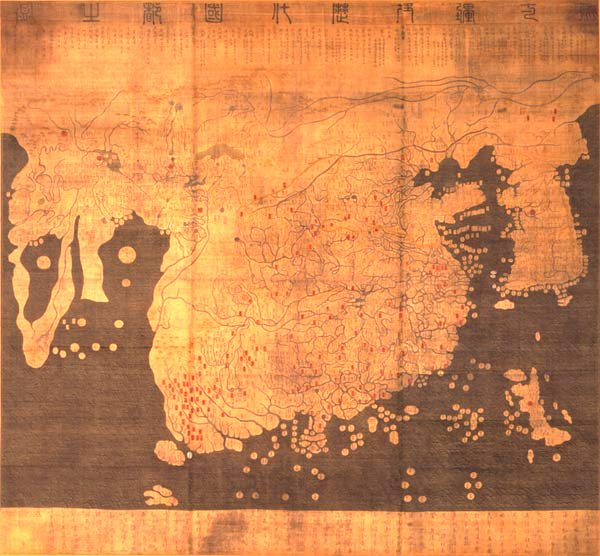
For the purposes of our discussion, we want to briefly look at how relations between nations at that time differed in the way that we would think today. For example, the concept of a tributary state is something that is very different to the current (or Western ) system that followed directly from the Thirty Years War in Europe or the Peace of Westphalia. Bruce Cumings writes:
"After another try, in 1845, the Chinese imperial commissioner in Hong Kong exlpained to the British that Korea "could not be opened to trade by China, for it was not a part of China" : nor could Korea open itself to trade, since "it was not independent."
In other words, basically, it's more of acknowledgement that our king acknowledges the supremacy of your king," but without any material, tangible benefits that say a colony might bring to a colonizing nation in the twentieth century. Cumings writes:
"Korea's seclusion policy was partly a reaction to foreign predations, but also expressed its national self-sufficiency, its acheivement of virtual economic autarky, and its valued place within the Chinese world order."
 Excluding the last condition, these words would be a fitting description of what both Koreas after the end of the Korean War.
 Issues of self-sufficiency helps to give us an understanding of why North Korea will not trade (that is answer why doesn't the country just give up self-sufficiency in food so that it can make money by specializing in manufacturing consumer goods when the country is clearly not suited to be an agricultural country). Of course, here, we should also note that North Korea has been at war against the largest consumer, the United States, and a superpower that also happened to control the petroleum regime for the past six decades.
Nonetheless, the same motivations can be seen in South Korea's adoption of import-substitution policies under military strongman, Park Chung Hee (he was a rather patriotic dictator, who not only loved Korea, but was also an officer in the Imperial Japanese Army and was also fluent in Japanese. This, of course, brings up the apparent paradox of being patriotic, yet still deciding to live in a Japanese-dominated Korean society). At any rate, while import substitution and export orientated development policies are standard East Asian fare today, at that time, the purchase (and that's what it really was, a purchase) of a large steel plant and plopping it into an agricultural country that was South Korea was desirable to South Korea in that it allowed the country to no longer be dependent on imports of foreign (I'm thinking primarily Japanese) steel and use that steel in industry.
Of course, to non-Koreans this smacked of lunacy, especially in the context of the Washington Consensus. Who in an agriculatural country would buy all that steel (of course, in hindsight, we can now say, well, of course, for Korean carmakers, shipmakers, and construction companies). But anyways, this same desire on the part of Koreans in the south to be feel self-sufficient gave way to what we now think of when we think of South Korea. Also, we should not discount that that a huge reason South Korea and not North Korea enjoyed so much success was that the South had access to a huge market and was secure in the knowledge that it could spend all its resources on making as much money as fast as possible among others...(the U.S. Army and its thousands of nuclear weapons should be cited here)...
Of course, to non-Koreans this smacked of lunacy, especially in the context of the Washington Consensus. Who in an agriculatural country would buy all that steel (of course, in hindsight, we can now say, well, of course, for Korean carmakers, shipmakers, and construction companies). But anyways, this same desire on the part of Koreans in the south to be feel self-sufficient gave way to what we now think of when we think of South Korea. Also, we should not discount that that a huge reason South Korea and not North Korea enjoyed so much success was that the South had access to a huge market and was secure in the knowledge that it could spend all its resources on making as much money as fast as possible among others...(the U.S. Army and its thousands of nuclear weapons should be cited here)...
And, of course, this should have been cited last week, but it's from Korea's Place in the Sun where I read the quote of a William Elliot Griffis who wrote in 1888:
While the entire body of Coreans, dignitaries, servants, merchants, and cartmen enter Peking, and all circulate freely in the streets among the people, the Chinese envoy to Seoul, must leave his suite at the frontier, and proceed to the capital with but a few servants, and there dwell in seclusion.
Again, history comes to give us another example of something we might find to be strange today (North Korea's minders whose specific job is to make sure foreigners, who come to Pyongyang are kept to specific parts) and this of course comes back to the Korean idea of Us versus Them or Good versus Bad or Civilized vs Barbaric or, perhaps, Safety vs Trouble, which itself comes from the millenia long history of a homogenous society.
Reading for Next Week:
Korea's Place in the Sun, Chapter 3 ("Eclipse" 1905-1945)
The Origins of the Korean War, Chapter 1 (Class and State in Colonial Korea)
Sunday, September 20, 2009
[Decal] Week 2: Why History Matters
Reading for this week is:
Pyong, Gap Min. "A Comparison of the Korean Minorities in China and Japan." International Migration Review 26.1 (1992): 4-21.
We will be going into Why History Matters, particularly when we talk about Korea and in trying to understand all the peculiar institutions in both North Korea and South Korea.
Also, a draft copy of this week's presentation has also been uploaded.
[Decal] Accessing JSTOR from off-campus...
If you need to access JSTOR from off-campus, all you need is your Calnet ID. Login instructions are pretty straightforward and it took me a good 15 seconds.
Instructions can be found here: http://www.lib.berkeley.edu/Help/proxy.html
Then, just click on the appropriate link which has the browser you're using.
Wednesday, June 17, 2009
Forming views on Korea, Part II : Reading, Korean Language
I wrote earlier that the sheer diversity of people I met in Korea had a huge impact on how I came to form my views on both Korea and Koreans. It’s tough not to stress how large of an impact this has had. Yes, I was born into a family of Korean immigrants and raised in Southern California with her huge Korean community. I was also raised in large part by my grandmother who speaks only Korean. Yet, it would be easy to say that just as English spoken by Kiwis (a term for New Zealanders I picked up in Seoul) is part of the larger English speaking language, Korean-Americans are a rather small (yet very influential) segment of the larger Korean community. For example, there's an article in the New York Times, that says Los Angeles has the highest population of Koreans outside of any city in Korea, but if there are 1 million Korean-Americans in all of Southern California, there are about 50 million in just South Korea where Korean is the dominant (and pretty much, only) ethnicity -- South Korea is more than just Seoul. Some of the things I took for granted that all Koreans might feel was just not there in the Koreans I met in Korea. For example, if I had to single out the most shocking thing I found out after first getting there, then it would undoubtedly have to be the Anti-Americanism. Before going there, I thought, why would anybody in South Korea hate the U.S.?
With all this, I would say the general life experiences I have had as a Korean-American in the United States and in South Korea goes hand in hand with the books I have read in forming how I view both Korea and Koreans.
Books/Newspapers:
Unfortunately, I don’t read books in my spare time anymore (most reading I do is done online now). Outside of school, I have not purchased a book since moving back to the States. I’m not sure why I don’t read as much now, but it would be hard not to stress how large of an impact the books I have read have had on forming my views. I’ve created a link that has the books I have read.
All the books I read are in English. My knowledge of the Korean language was so terrible when I first got to Korea; conversational Korean was so difficult such that reading college level books was simply not an option. Even English loan words (of course, now a part of the South Korean variant of the Korean language) were pronounced differently there. For example, the word for “camera” in Korean is just the Korean pronunciation of “camera.” Of course, there are multiple ways to pronounce it, but only one way that’s actually a part of the Korean language and could be understood by Koreans. I pronounced camera Kae-Meu-Ra (케므라 versus Ca-Mae-Ra, 카메라 ) at first, and, of course, nobody would understand. And then, there is an unwritten social rule where you simply can’t say “Camera” in English while you speak Korean in South Korea (and there’s a good chance it wouldn’t be understood either).
But, while in South Korea, things were different. Maybe, it was the culture there. A few years back, when a friend from back home was visiting, I remember going to casually grab some coffee only to go to Kyobo Bookstore (Gangnam, Seoul) right after. I remember actually sitting down and reading. My friend found some books on poetry and spirituality and was reading those (Rest in Peace Brother). We sat there and just read. We were there for I’d say about a couple hours, but if we were at the Kyobo Bookstore in Gwanghwamun with its much larger selection, I bet we would’ve stayed there longer. The books made a huge impact on my views on Korea.
With all this, I would say the general life experiences I have had as a Korean-American in the United States and in South Korea goes hand in hand with the books I have read in forming how I view both Korea and Koreans.
Books/Newspapers:
Unfortunately, I don’t read books in my spare time anymore (most reading I do is done online now). Outside of school, I have not purchased a book since moving back to the States. I’m not sure why I don’t read as much now, but it would be hard not to stress how large of an impact the books I have read have had on forming my views. I’ve created a link that has the books I have read.
All the books I read are in English. My knowledge of the Korean language was so terrible when I first got to Korea; conversational Korean was so difficult such that reading college level books was simply not an option. Even English loan words (of course, now a part of the South Korean variant of the Korean language) were pronounced differently there. For example, the word for “camera” in Korean is just the Korean pronunciation of “camera.” Of course, there are multiple ways to pronounce it, but only one way that’s actually a part of the Korean language and could be understood by Koreans. I pronounced camera Kae-Meu-Ra (케므라 versus Ca-Mae-Ra, 카메라 ) at first, and, of course, nobody would understand. And then, there is an unwritten social rule where you simply can’t say “Camera” in English while you speak Korean in South Korea (and there’s a good chance it wouldn’t be understood either).
So, to put it mildly my knowledge of the Korean language was even worse; I never attended Korean language school when I was growing up. Many words that I had learned from my parents while growing up were also no longer in use (elementary school 초등학교 vs 국민학교, yellow radish 단무지 vs 다광(sp?)). When I took courses at Yonsei University’s Korean Language Institute during the early part of my stay in South Korea I was taking introductory language classes (Level 1).
But, while in South Korea, things were different. Maybe, it was the culture there. A few years back, when a friend from back home was visiting, I remember going to casually grab some coffee only to go to Kyobo Bookstore (Gangnam, Seoul) right after. I remember actually sitting down and reading. My friend found some books on poetry and spirituality and was reading those (Rest in Peace Brother). We sat there and just read. We were there for I’d say about a couple hours, but if we were at the Kyobo Bookstore in Gwanghwamun with its much larger selection, I bet we would’ve stayed there longer. The books made a huge impact on my views on Korea.
Back then, there were two major English dailies, the Korea Times and Korea Herald. I almost exclusively read the Korea Herald on a daily basis. The newspaper along with an mp3 player and a book were all essential parts of my life back then. Public transportation in Seoul is very well developed (I remember spending KRW550,000 or about $500 at the time to buy my first i-pod – the 2nd generation one).
Subscribe to:
Posts (Atom)