Monday, March 1, 2010

*Draft* The Hungarian Language

So, I was in the elevator in my apartment today and as the elevator is the size of a small closet -- it's super awkward not to to strike up a conversation. There was this one guy in there that I never saw before and he had an accent and I asked him where he was from. "Hungary," he said.

And, I remember I had this one English conversational partner in Korea, who spoke Hungarian, Korean, and Japanese. He told me that there were similarities in the Hungarian language on one hand and Korean and Japanese on the other -- the latter two languages, for the most part -- can literally be translated character for character without any grammatical mistakes. Both languages are also characterized by having a complex set of verb conjugations that address the relative social rank of the listener, not to mention the formality of a situation. It's also been argued that people on the Korean Peninsula and Western Japan ("Wa Japan"/倭) spoke mutually intelligible languages until about the 7the century (about the time Silla unified the Korean peninsula). 

Note: I know I've been searching for this paper I read a while back with the title along the lines of "Japonic-Gorguyeo languages(?)" published in like 2002/03 or so by some academic in I think Pennsylvania. Please e-mail me this article if you come across it.

Note: After reading the article, I really got no better sense of how the Hungarian language is. I'll come back to this topic when I have something...
But, I do that know that some linguists classify all three languages under a single language family: Ural-Altaic languages. Yes, that's from Hungary (and even Finland ) all the way through Central Asia and to East Asia (skipping over areas that are now populated by only Mandarin speakers, but were not so a couple centuries back). Yes, you might think it's broad, but you should check out the Indo-European language family that not only includes the Romance Languages (French, Italian, Spanish, and Romanian), but also all of Europe minus the ancient Basque region, where I stopped by out of historical interest during a backpacking trip to Europe last summer. It also includes most of the languages found in Iran and India.


Anyways, as I told the guy in the elevator that I had heard Hungarian was actually related or similar to some languages in East Asia, I asked him if their were honorifics. Surprisingly, he said, yes, they address older people differently than they do younger people. So, as I write my midterm paper, I was curious to Google (or better yet, Wikipedia it). Now, I'm no linguist and I'm not sure if there is even a connection here (I'm not sure if there are even honorifics in Turkish or Mongolian, but I think perhaps that can be a talking point next time I randomly meet somebody from Turkey or Mongolia. I do know there is a store here that is owned by a Mongolian immigrant right down the street).


Hungarian has a four-tiered system for expressing levels of politeness.
Much like Japanese, the Korean language has complex gradations. It uses honorifics and no less than seven speech levels, each with a singular/plural distinction, making for fourteen basic verb stems. Nevertheless, most levels have all but disappeared from everyday language, so one can simplify this into the basic distinction between plain and polite conjugations of verbs and adjectives. In general, the plain form is used when speaking to family, close friends, and social inferiors, and the polite form otherwise. When two Korean-speaking strangers meet where none is the obvious social superior, both use the polite form; when it is determined that one or both can switch to the plain form, one often asks for permission for this switch. The phrase used to describe this is 말을 놓다 mareul nota (literally “to release language”). In Korean, the polite form is called 존댓말 jondaenmal and the plain form is called 예사말 yesanmal or 반말 banmal. In contrast to the neutral term 예사말 yesanmal, 반말 banmal (literally “half speech”) often has a rather negative connotation, referring for instance to the plain form that one may deliberately use to provoke someone who should be addressed in the polite form.

There is a similar phenomenon called 높임말 nopimmal, which is honorific speech triggered not by the addressee but by the content of an expression. It is used independently of the speech levels. For example, in -하십니다 -hasimnida “do(es) …”, the speaker uses the infix -si- to honour the subject of the sentence and the ending -mnida to express courtesy or politeness (or simply his distance) towards the addressee. As the subject of the sentence and the addressee do not have to be the same person both forms can be mixed. The speaker can honour a higher person he is talking about with the infix -si- while talking to a friend who is addressed in the informal banmal.
In Japanese, as in Vietnamese, kinship terms, titles, or names are commonly used instead of first-, second- or third-person pronouns; real personal pronouns do not exist in the language, and the words most closely corresponding to them are grammatically nouns. As in Korean, there are several levels of politeness regarding social hierarchy, and polite language encompasses not only pronouns but also verb endings and vocabulary as well. (See the articles Japanese pronouns and Honorific speech in Japanese for more information.)
On a side note: It's accepted that Vietnamese is not related to Japanese at least in terms of origins of the language. Vietnamese along with Chinese and Tibet are part of the Sino-Tibetan language family.

Maybe I was sitting next to a NK refugee...("탈북자, 전 세계 23개국에 정착" - RFA)

Found this gem at One Free Korea.

The picture to the left is from Yonhap News found in the article: "탈북자, 전 세계 23개국에 정착 [North Korean Refugees have been accepted in 23 countries around the world]" (Radio Free Asia). The table below is also from the same article, but it's from the UNHCR. While the original article is in Korean (that's within my grasp of understanding), there's not much of particular interest there that can't be seen from the chart below. However, One Free Korea does take a deeper look at the chart.
Check the table to the right. It seems Germany and the United Kingdom have accepted a rather large number of refugees.

This reminds me though. As I was backpacking in Europe last summer, I sat next to this Korean woman that was around my mother's age in France -- I was headed to Versailles. She too said she had to get off at that exit and she was actually headed to work. I believe she had a menial job there and thought it rather unfortunate. And, by the way, I remember thinking France - well at least Paris,  seemed a lot more cosmopolitan and open to immigration and resembled the United States a lot more in this regard than the United Kingdom (I had the great fortune of being able to travel all over the U.K. - including Scotland, Wales, and Northern Ireland (by boat) while I was taking classes at LSE in London). The United Kingdom on the other hand just seemed like a backwards, yet very expensive version of the United States in terms of culture and language. Some of their phrases posted on those street signs seemed so awkward...

But, anyways, the strange thing is, she had this rather peculiar accent -- very peculiar. And, I did meet plenty of ethnic-Korean Chinese in South Korea. Most of the ones I came across - however - had very strong, almost Chinese accents when speaking Korean. However, this lady was native in Korean, but she just had a rather strange accent and she did "accidently" say "Joseon Mal" rather than "Hanguk Mal" while we were conversing (They both mean the Korean language). However, Joseon is used as written in the posts below only by Korean-Chinese, North Koreans, and, perhaps, a few Korean-Japanese. When I finally asked this lady where she was from, there was this like awkward pause as she told me she was an ethnic-Korean Chinese from the Yanbian Korean (Joseon) Autonomous  Region in Jilian Province in NE China (연변 조선족 자치주, 中文: 延邊朝鮮族自治州). So, I don't know. I wonder how she got there and how she's doing now. Perhaps, she was one of those lucky few that managed to escape the living hell that is North Korea or not...

Anyways, should get back to my papers...

Sunday, February 28, 2010

Chinese-Koreans in California ("화교")

I mentioned 50,000 ethnic Chinese-Koreans ([한국]"화교", 韓國華僑, 韩国华侨) living in South Korea out of a population of about 50,000,000. Well, I looked it up on the great free online encyclopedia that is Wikipedia and it actually cites a figure of 624,994 (2009, 71% of which are ethnic Koreans), but these represent all people with Chinese citizenship. And, rather than refer to the recent migrants, I was referring to the historic Chinese population dating back to 1882 -- fourth or fifth generation ethnic-Chinese Koreans that have largely retained their culture and language, while speaking perfect Korean. The site mentions:

It is estimated that only 26,700 of the old Chinese community now remain in South Korea; they largely hold Republic of China nationality.
And that:
Due to the South Korean regulations in the 1960s which limited foreign property ownership, many Chinese in South Korea left the country.[30] During the 1970s, 15,000 are estimated to have moved to the United States, and another 10,000 to Taiwan.
Amazingly, there are many Chinese-Koreans in California. If you're in the Berkeley-Oakland area, there are two Chinese restaurants on opposing sides of Telegraph Avenue in Oakland. One of which, I know is owned by an ethnic-Chinese Korean family. In even the smallest of Korean communities, there's a good chance that the local Chinese restaurant that sells Sino-Korean dishes (such as Jja-jang myeon or 짜장면, I'm not sure what to call these dishes as I believe people in China proper do not eat them), then there's a good chance they are owned by 4th or 5th generation, ethnic Chinese-Koreans that have migrated from South Korea. In Los Angeles, there's so many of these restaurants that it's not difficult to meet Chinese-Koreans, but if you're in San Diego, the Chinese restaurant in the Asian business area of Convoy is also owned by a Chinese-Korean family. Their Korean is perfect so it is hard to distinguish that they are indeed ethnic Chinese. I find it amazing that from such a small community (say 50,000), many now live in California.

Talk about a direct connection with history.

Anyways, yes, I ate jja-jang-myeon (black bean noodles?) yesterday.

[DeCal] Readings - March 2nd and March 9th

The readings can be found here:

http://northxkorea.blogspot.com/2009/09/decal-end-of-history.html
http://northxkorea.blogspot.com/2009/10/decal-korea-as-japanese-colony-reading.html

[DeCal] *Edited* Review - Korean History: 2333 BCE to 1876 CE

As promised, Leah Yi and Tori Bazz's presentation and review of Korean History: 2333 BCE to 1876 CE can be found here. And, all presentations that are available online can be found by scrolling down on the right hand side.

Remember, the point of this course is not to dwell on history, but to use it as a tool to better understand contemporary events. With this in mind, names of figures or even names of kingdoms become rather irrelevant then. Naturally, then what is clear from our understanding of Korean history is this:

The borders of Korea have more or less remain unchanged since the unification of Korea by Silla in the 7th century CE and there have been no significant movement or immigration to the peninsula (until perhaps the last decade or so) since the fall of the last Han commandery called Lolang in 313 CE. Thus, Korea has had a single group of people - more or less (for more, I mentioned the Korean Haplogroup - O2b, which is present in a significant number of males on the Korean peninsula and the Japanese peninsula, but absent among China's population), who have come to speak the same language over the course of 1,300 years.

Note that France was united around the first decade of the sixteenth century (I believe), Spain - 1492, Germany & Italy - 1870, Russia - I believe some time in between - I think most of what is Russia today was occupied by remnants of the Golden Horde (or Mongols) until the 16th or 17th centuries... So, you can imagine why Korea could be so nationalistic and so xenophobic (not a single minority ethnic group). I believe Korea and Japan are the only two countries, where you'll find almost no ethnic Chinese communities in significant numbers in all of East Asia. Up until recently, I believe there were 50,000 ethnic Chinese out of a population of almost 50 million (about 0.1%).

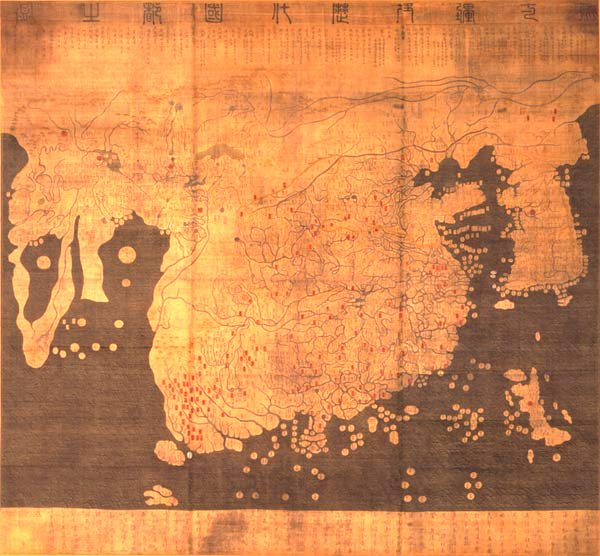
In this context, the issue of whether these kingdoms, such as Goguryeo (高句麗) or Balhae (渤海) were "Korean" are rather unimportant and, perhaps, even irrelevant next to how it is the merger of the separate kingdoms' people and culture (for more: check out Samhan/Buyeo, 三韓/夫餘 - in Sino-Korean/扶餘 - in traditional Chinese script) that gave rise to the singular identity of a Korean people. This is probably the most important theme to take from ancient Korean history (along with the geography of the Korean peninsula and the geographical location of the Korean peninsula). Also, I mentioned the Gangnido Map (and how it has a really long name. Wikipedia cites the term, "Honil Gangni Yeokdae Gukdo Jido ("Map of Integrated Lands and Regions of Historical Countries and Capitals", 혼일강리역대국도지도, 混一疆理歷代國都之圖) for the map. Nonetheless, it is an easy and quick way to visualize how Koreans saw themselves in relation to the outside world during the Joseon dynasty.  

Also, as discussed in class, I claimed that the North South States Period (남북국시대, 南北國時代) is a recent construct as it refers to a time when Silla (then Goryeo) controlled the bottom two thirds of the peninsula, but the rest was controlled by first Goguryeo (then Balhae) and the origins of the theory come from works during the mid Joseon period about a millenia later in the book Samguk Yusa (三國遺事). I also mentioned how this is used by modern (South) Korean scholars to justify the division of the Korean Peninsula.

Also, the name of the last Korean kingdom was touched upon and how it refers to North Koreans today in both the Koreas, all the Chinese languages and Japan. Perhaps, it's best understood by the Sino-Korean characters (or traditional -- classical? -- Chinese script): North Korean (Joseon Person (朝鮮人)) vs South Korean (Hanguk Person (韓國人)). Actually on second though, In South Korea, 朝鮮人 would probably refer to somebody from the Joseon Dynasty and the term 朝鮮族 would refer to ethnic Korean-Chinese (that have lived in China since around 1880. For more, See A Comparison of the Korean Minorities in China and Japan by Pyong, Gap Min). In both North and South Korea, they would just add the term South or North in front of their word for Korea. So, the term for North Korean would just be North (Hanguk Person) in South  Korea, while the term for South Koreans would just be South (Joseon Person) in North Korea.
 
Interestingly, in China the latter term was not used until after normalization of ties with South Korea. The term Hanguk actually derives from the period 1897-1905, when the Joseon dynasty fully joined the Westphalian (Western/Modern) International Order and which we have not yet discussed -- when it was no longer considered a vassal state after the first Sino-Japanese War (Became, the Great Empire of the Han People (not to be confused with the term Han used for Han Chinese (漢) vs Han (韓) Koreans)). On a side note, this is precisely the reason why classical Chinese characters are important as in both the Korean and Japanese languages there are a large number of homonyms that can't be described by words constructed from an alphabet (this is precisely why Kanji (literally Chinese Script or Sino-Japanese characters) are still in heavy usage in Japan and many (should) be in usage in the Koreas today...I believe -- there are 5 vowels in the Japanese language and no differences made through pitch. Korean is much the same except with a larger number of vowels and for the most part a single pitch as well).

 The historical connection between the Joseon Dynasty (the Hermit Kingdom, Land of the Morning Calm) and North Korea becomes very straight forward when thought in this light (and as we shall see over the rest of the semester).

Thursday, February 25, 2010

[DeCal] Groups presentation dates/topics/readings


*refer to required/recommended readings on spring 2010 syllabus! if there is no link provided you can try googling.. if that doesnt work, email! koreandecal10@gmail.com
GROUP 1: MARCH 9th
Eruption of Fissures: The Korean War as a Civil War (1945 1953)
Presentation: Civil War
Fissures in Korean society were not able to be reconciled as the Korean (Civil) War became just

a single battle and the opening shots of the larger, Cold War fought between the United States

and the Soviet Union. National reconciliation never occurred and this had profound implications in

the development of North Korea. 


GROUP 2: MARCH 16th
Divergence in Institutions Part I (South Korea)

Presentation: Divergence in Institutions I (South Korea)
Why is it that the southern half of the Korean peninsula came to be a fairly wealthy, middle

income country with democratic institutions? How did this process happen? After all, Korea was

for thousands of years a centralized bureaucratic monarchy (and then ruled by centralized

bureaucratic colonial government) with no history of democracy? The presentation will heavily

emphasize the development of economic institutions first that began in the early seventies.

Policies conducive to sustained economic growth over the long run that took advantage of

favorable endowments unique to South Korea (access to the U.S. market, U.S. oil regime) led to

prosperity in the South. Democratic institutions also took hold, but took much longer with South

Korea holding her first free and fair elections in 1987). 


GROUP 3: MARCH 30th
Divergence in Institutions Part II (North Korea)

Presentation: Divergence in Institutions II (North Korea)
How did the Korean War effect the development of North Korean institutions? How does North

Korea fit in historically into Korean history? Many of the peculiarities of the North Korean state

have a historical rationale behind it. The notion of North Korea being a hermit nation began only

after the Korean kingdom of Joseon was invaded by the Mongolians, Japanese, and then the

Manchurians. In more modern times, of course, the Sino-Japanese War, the Russo-Japanese

War, and even the Korean War were also largely fought to answer the question of who would

hold sway over the Korean peninsula. Xenophobia against even diplomats in Pyongyang also

holds a historical precedent during the Joseon dynasty when Ming diplomats were not allowed to

roam the streets without of a guide. 


GROUP 4: APRIL 6th
Famine

Presentation: Famine in North Korea and its after effects.

Presentation will briefly go over why the famine occurred in the first place, but emphasis will be

placed on how this has changed North Korean society permanently. 

Wednesday, February 24, 2010

Woodblocks, Metaltype Printing in Goryeo

I went back to Los Angeles this past Friday for a friend's birthday and more -- on Sunday Morning, I took my grandmother to the Korea (Goryeo) Buddhist Temple (고려사, 高麗史) in Los Angeles. I'm not a religious person as in, perhaps, I consider myself to be spiritually devoid -- though that seems to take on too much of a negative connotation here, but my core values and interests overlap with that of tradition, family, and history.

These sermons are very difficult for me to follow the sermons and the chants/recitations make no sense to me whatsoever. To me they are all archaic Sino-Korean characters (next to each Korean character is a Hanja character), so it's difficult to follow what goes on (of course, the interesting topic to pursue, would of course be on how to make Korean Buddhism relevant in today's Korea).

Fortnuately, a large part of Sunday's sermon revolved around the history of Woodblocks and Metaltype Printing done during Goryeo of Buddhist scripture. On a side note, my grandmother whispered to me that "you are so lucky that you came today." She knows that I do have a deep interest in Korea (I ask her all the time how life was like when she was young).  So, while usually I would have a difficult time following the sermon, it was somewhat easier this time as I had read up a little bit on the topic of woodblock and metaltype printing done in Goryeo.

Moveable metaltype printing is claimed to have first been developed in Goryeo (a Korean dynasty preceding Joseon), though woodblock prints have a history of much more extensive usage in Korea for a number of reasons. And, just as the Bible was the first book to be published in the West, so was Buddhist text printed in the Far East. However, unlike the Bible, and please, I'm not here to argue who invented what first or to even acknowledge that it's relevance in this discussion (though I do put up a link below on this topic below), but this printing could be considered a wonder of the world. It's not just a book that was printed, but an entire library. 

It [The Tripitaka Koreana, 팔만 대장경, 八萬大藏經] is the world's most comprehensive and oldest intact version of Buddhist canon in Chinese script, with no known errors or errata in the 52,382,960 characters which are organized in over 1496 titles and 6568 volumes. Each wood block measures 70 centimeters in width and 24 centimeters in length. The thickness of the blocks range from 2.6 to 4 centimeters and each weighs about three to four kilograms (The Tripitaka Koreana, Wikipedia).
It is and has been housed in Haein-Sa temple (해인사, 海印寺) for centuries now and was originally created so that Buddha would help defend the country from Khitans (early Manchurians). Anyways, I wanted to get a better idea of the Tripitaka Koreana/PalMan Daejanggyeong, so I thought I'd share a site that might be of interest to others as well.

For its historical relevance in terms of how it influenced East Asian Buddhist Scripture, check the UNESCO listing. For how it may have influenced the West (well and then the world over again), check out Gutenberg and the Koreans: Did East Asian Printing Traditions Influence the European Renaissance? (Thomas Christensen)